Skip to content
Example: Heating raw rice (cause) makes it soft (effect/change).Example: Ripening (cause) turns a green tomato red (effect/change).
Natural Changes: Occur spontaneously in nature and are beyond human control.Examples: Change of seasons, melting of glaciers, volcanic eruptions, earthquakes, formation of coal from dead matter, growth of a seedling.Human-Made Changes: Occur due to human efforts, activities, or interventions.Examples: Cooking food, weaving cloth, making chapatis, paper boat making, burning fuel.
Slow Changes: Take a long time to complete (hours, days, months, or years).Examples: Rusting of iron, growth of a tree, tooth decay, seed germination, formation of coal and petroleum.Fast Changes: Take a very short time to complete (seconds or minutes).Examples: Burning a matchstick, bursting of crackers, beating of the heart, lighting an electric bulb, bursting an inflated balloon.
Desirable Changes: Changes that are beneficial to humankind and are wanted.Examples: Formation of curd from milk, cooking of food, drying of clothes, ripening of fruits.Undesirable Changes: Changes that are harmful to humankind and are unwanted.Examples: Spoilage of food, flooding of rivers, occurrence of earthquakes and diseases.Dual-Nature Changes: Some changes are desirable or undesirable depending on the context:Cutting of trees: Desirable for making paper and furniture; undesirable because it causes soil erosion and flooding.Rainfall: Desirable for farmers during sowing; undesirable during harvesting.
Periodic Changes: Occur at fixed, predictable intervals of time.Examples: Occurrence of day and night, sunrise/sunset, full moon/new moon, tides, swinging clock pendulum.Non-Periodic Changes: Do not occur at fixed intervals of time.Examples: Landslides, volcanic eruptions, coughing, thunder and lightning, occurrence of diseases.
Reversible Changes: Can be reversed easily by changing the conditions to obtain the original substance.Examples: Melting of ice, boiling of water, dissolving common salt in water, glowing of a bulb, stretching a rubber band.Irreversible Changes: Cannot be reversed to obtain the original substance under any conditions.Examples: Burning of paper, curdling of milk, ageing of living organisms, weathering of rocks, grinding wheat into flour, rusting of iron.
It is temporary and generally reversible.No new substance is formed.Only physical properties (size, shape, color, state) change.Generally, no overall change in energy (heat/light) takes place.The chemical properties and composition of the substance remain the same.
Melting and Freezing: Interconversion of states of matter (Solid ⇌ Liquid) at fixed temperatures on heating/cooling.Boiling and Condensation: Liquid ⇌ Gas phase changes.Evaporation: A slow, surface-level process where a liquid changes to gas at temperatures below its boiling point by absorbing heat from the surroundings (causing cooling).Dissolving: Mixing a solute into a solvent (e.g., salt in water). The solute can be retrieved in its original form by evaporating the liquid.Sublimation and Deposition: Sublimation is the direct transition of a solid to gas on heating (e.g., camphor, iodine, solid carbon dioxide/dry ice, naphthalene, ammonium chloride). Deposition is the direct transition of gas to solid on cooling.
It is permanent and cannot be reversed by simple physical methods.One or more entirely new substances are formed.Both physical and chemical properties of the substance change.The chemical composition of the substance changes.A large amount of energy (heat, light, or sound) is either released or absorbed.
Change in color (e.g., sliced apples turning brown in open air).Evolution of a gas (e.g., zinc reacting with acid).Formation of new products.Release or absorption of heat, light, or sound energy.
Zinc Granules + Dilute Hydrochloric Acid: Creates zinc chloride and hydrogen gas. Bubbles are evolved, heat is released (exothermic), and the hydrogen gas burns with a “pop” sound.
 Rusting of Iron: Iron nails kept in tap water for days develop a reddish-brown coating called rust (hydrated iron oxide). It is permanent and irreversible.Heating Iron Filings and Sulphur Powder: Heating this mixture strongly forms a new compound, iron sulphide (
  ), which loses magnetic properties (unlike a simple unheated mixture where iron can be separated with a magnet).Heating Sugar: Sugar melts, turns reddish-brown, and eventually forms a sweetless black residue called charred sugar (carbon), alongside carbon dioxide and water vapor.Photosynthesis: Plants absorb solar energy to produce glucose and oxygen from carbon dioxide and water:
 Respiration: Digested glucose reacts with oxygen inside living cells to release energy:

Endothermic Changes: Heat energy is absorbed from the surroundings.Examples: Vaporization of spirit/perfume on the skin (feels cold), melting ice on the palm, dissolving glucose in water, dissolving ammonium chloride in water.Exothermic Changes: Heat energy is released into the surroundings.Examples: Burning of fuels (coal, wood, LPG, petrol), burning a matchstick, dissolving quicklime in water (produces a hissing sound and makes the container hot).
Physical Change: Solid wax melts to liquid wax due to heat, which can freeze back to solid wax on cooling.Chemical Change: Molten wax rises through the wick, vaporizes, and burns in air to produce carbon dioxide, water vapor, heat, and light.
Cooking food: Fast, desirable, irreversible, human-made, chemical change.Melting butter: Fast, desirable, reversible, human-made, physical change.Curd from milk: Slow, desirable, irreversible, human-made, chemical change.Fermentation / Digestion: Slow, desirable, irreversible, chemical change.

Share
Explore
 Recap Hub
Chapter: 02. Physical And Chemical Changes
Chapter 2: Physical and Chemical Changes — Revision Crash Course
1. Introduction to Changes
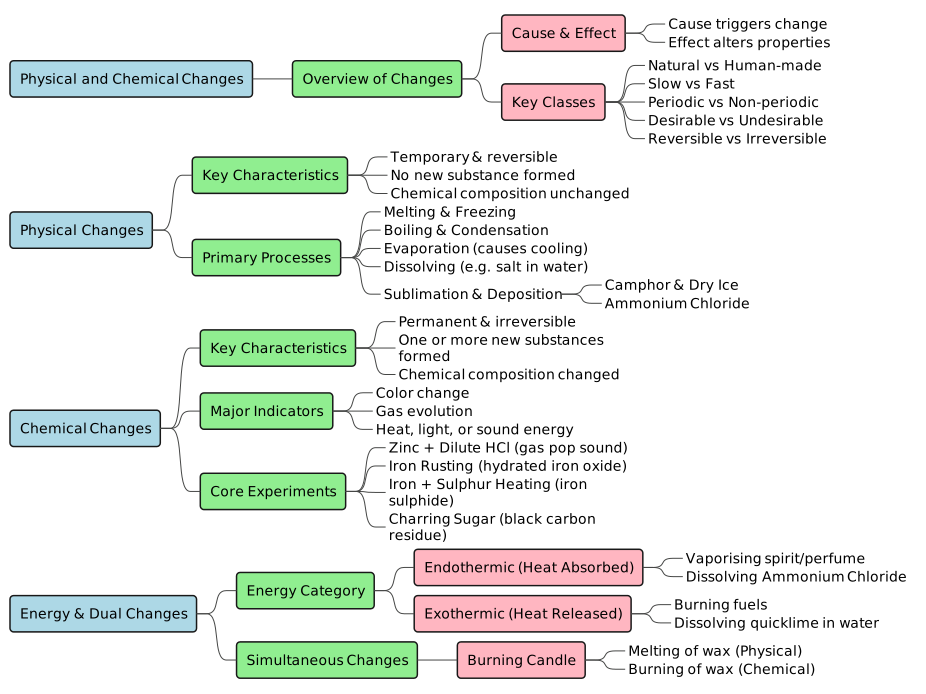
Change is a fundamental law of nature, constantly occurring around us. Every change has a cause (the reason behind it) and an effect (the resulting alteration in properties like color, size, shape, hardness, position, composition, odor, taste, or temperature).
2. Classification of Changes
Changes are classified into distinct categories based on their origin, speed, desirability, timing, and reversibility:
A. Natural vs. Human-Made Changes
B. Slow vs. Fast Changes
C. Desirable vs. Undesirable Changes
D. Periodic vs. Non-Periodic Changes
E. Reversible vs. Irreversible Changes
3. Physical Changes
Definition
A change in which only the physical properties (shape, size, color, and state) of a substance change, while its chemical composition and properties remain completely unaltered. No new substance is formed.
Characteristics of Physical Changes
Key Processes of Physical Change
Differences Between Evaporation and Boiling
1.
It is a slow process.
It is a fast process.
2.
It takes place only from the surface of the liquid.
It takes place throughout the entire liquid.
3.
It takes place at all temperatures.
It takes place at a particular, fixed temperature.
4.
It causes cooling.
It does not cause cooling.
4. Chemical Changes
Definition
A change in which the chemical composition and properties of a substance are permanently altered, resulting in the formation of one or more new substances.
Characteristics of Chemical Changes
How to Identify a Chemical Change
Core Experiments and Examples
5. Changes Involving Energy
During chemical and some physical changes, energy is transferred.
6. Simultaneous Changes: The Candle
When a candle burns, both physical and chemical changes take place at the same time:
7. Differences Between Physical and Chemical Changes
S. No.
Parameters
Physical Change
Chemical Change
1.
New Substances
No new substance is formed.
One or more new substances are formed.
2.
Nature of Change
It is generally a temporary change.
It is a permanent change.
3.
Reversibility
It is generally reversible by physical methods.
It is generally irreversible by physical methods.
4.
Properties
Only physical properties (size, shape, color, state) change.
Both physical and chemical properties change.
5.
Energy Change
Generally, no overall change in energy takes place.
Energy (heat, light, sound) is absorbed or released.
8. Multi-Categorized Changes
Some common changes belong to multiple classifications at once:
Want to print your doc?
This is not the way.
This is not the way.

Try clicking the ··· in the right corner or using a keyboard shortcut (
CtrlP
) instead.