Skip to content
Biological Classification: The process of grouping living organisms based on similarities and separating them based on differences.Taxonomy: The branch of biology dealing with naming and classifying organisms.Father of Biology: Aristotle (introduced the initial classification process).Father of Taxonomy: Carl von Linnaeus (Swedish botanist who published Systema Naturae in 1735 and laid the foundation for biological naming).
Scope: To easily study over 12 lakh types of animals and 3 lakh types of plants.Key Advantages:Simplifies the study of a wide variety of organisms.Aids in the identification of new organisms.Reveals relationships between different groups.Illustrates evolutionary pathways from simple to complex organisms.
 Species: The basic unit of classification. A group of closely related organisms capable of breeding among themselves to produce fertile offspring.
Kingdom Plantae: Green organisms, containing chlorophyll, capable of preparing their own food (autotrophic), stationary.Kingdom Animalia: Organisms lacking chlorophyll, unable to prepare food (heterotrophic), mobile.
Kingdom Protista: Unicellular organisms (some autotrophic, some heterotrophic).Kingdom Plantae: Multicellular autotrophic plants.Kingdom Animalia: Multicellular heterotrophic animals.
Features: Simplest unicellular organisms lacking a defined nucleus and membrane-bound organelles (mitochondria, chloroplasts, ER, Golgi bodies). Naked, single circular DNA.Bacterial Shapes:Cocci: SphericalBacilli: Rod-shapedSpirilla: SpiralVibrio: Comma-shapedMedicinal Uses:Antibiotics: Produced by bacteria to inhibit pathogens (e.g., streptomycin, erythromycin, chloromycetin).Serums & Vaccines: Serums contain antibodies for immunity; vaccines consist of killed pathogenic bacteria to induce antibody formation.Intestinal Aid: Escherichia coli in the human intestine synthesizes Vitamin B-complex. Cellulose-digesting bacteria help herbivores digest grass.Industrial Uses:Curd & Cheese: Lactobacillus converts lactose sugar in milk to lactic acid.Retting of Fibres: Clostridium butylecum separates jute and hemp fibres.Biogas: Anaerobic bacteria degrade waste to produce methane.Agricultural Uses:Nitrogen Fixation: Rhizobium in root nodules of legumes converts atmospheric nitrogen to nitrates.Nitrification: Nitrobacter converts ammonia in the soil to nitrates.Denitrification: Pseudomonas converts soil nitrates back into gaseous nitrogen.Harmful Activities: Causes diseases (e.g., cholera, typhoid, tuberculosis), spoils food, and can be used as bioweapons (e.g., Bacillus anthracis).
Features: Unicellular with a defined nucleus and membrane-bound organelles.Locomotion Structures:Cilia: Hair-like structures (Paramecium)Flagella: Whip-like structures (Euglena)Pseudopodia: False feet (Amoeba)Amoeba Anatomy & Physiology:Covered by a thin cell membrane; cytoplasm contains a nucleus, contractile vacuole (excretion of ammonia and excess water), and food vacuoles (digestion).Respiration: Gas exchange occurs via simple diffusion through the cell membrane.Reproduction: Binary fission under favorable conditions; Multiple fission (cyst formation) under unfavorable conditions.
Features: Non-green, heterotrophic eukaryotes. Cell walls are made of chitin.Structure: Composed of thread-like structures called hyphae, which collectively form a network called mycelium.Bread Mould (Rhizopus / Mucor):Cell wall contains fungal cellulose.Three hyphae types: Stolons (parallel to substrate), Rhizoidal hyphae (root-like anchors), and Sporangiophores (erect stalks bearing spore-producing sporangia).Nutrition: Extracellular digestion (secrete enzymes externally, absorb digested glucose).Economic Importance:Food: Edible mushrooms (Agaricus, Morchella) are protein-rich; Yeast is used in baking (aerobic fermentation) and brewing (alcohol).Medicine: Discovery of Penicillin (the first wonder drug) from Penicillium notatum by Alexander Fleming in 1929.Harmful Effects: Food spoilage (Mucor, Rhizopus); human skin diseases (ringworm, athlete’s foot); plant crop diseases (rust in wheat, late blight of potato).
Thallophyta (Algae):Simplest plant body, not differentiated into roots, stem, or leaves (thallus).Contain chlorophyll (autotrophic).Examples: Chlamydomonas (unicellular), Spirogyra (filamentous), Volvox (colonial).Bryophyta (Mosses & Liverworts):Known as the amphibians of the plant kingdom (require moisture to survive/reproduce).Have stems and leaves but lack true roots; anchored by thread-like rhizoids for absorption.Non-vascular (no xylem or phloem).Examples: Moss, Liverwort, Hornwort.Pteridophyta (Ferns):Body differentiated into true roots, stem (underground rhizome), and leaves.Vascular plants (contain developed xylem and phloem).Do not produce flowers or seeds; reproduce via spores produced inside sori (singular: sorus) on the undersurface of their leaves.Examples: Dryopteris, Equisetum (horsetail).Gymnosperms (Naked Seeds):Primitive seed-bearing plants; do not produce true flowers or fruits.Seeds develop naked inside cones (male cones produce pollen; female cones contain ovules).Vascular system lacks vessels in xylem and companion cells in phloem.Leaves are long and needle-shaped to conserve water and resist snow damage; mostly evergreen.Examples: Pine, Fir, Cedar, Gingko, Cycas.Angiosperms (Enclosed Seeds):Highly evolved, successful, and numerous land plants.Bear true flowers; seeds develop inside an ovary, which matures into a protective fruit.Vascular system is highly developed (xylem has vessels, phloem has companion cells).Monocotyledons (Monocots): Seeds contain a single cotyledon (seed leaf). Have parallel leaf venation. Examples: Maize, Wheat, Rice, Grasses.Dicotyledons (Dicots): Seeds contain two cotyledons. Have reticulate leaf venation. Examples: Gram, Pea, Bean, Mango.

Share
Explore
 Recap Hub
Prepared by: learnloophq@gmail.com
Chapter: 02. Kingdom Classification
2 Kingdom Classification — Revision Crash Course
1. Introduction to Classification & Taxonomy
Need and Advantages of Classification
2. Taxonomic Hierarchy
Carl von Linnaeus originally introduced four categories (class, order, genus, species). Later additions (family, phylum, kingdom) expanded this to seven major taxonomic ranks:
3. Historical Systems of Classification
Two-Kingdom System (Linnaeus, 1758)
Three-Kingdom System (Ernst H. Haeckel, 1866)
Five-Kingdom System (R. H. Whittaker, 1969)
Based on cell complexity (prokaryote vs. eukaryote), cell number (unicellular vs. multicellular), and mode of nutrition:
Kingdom
Cell Type
Cellularity
Cell Wall
Nutrition Mode
Examples
Monera
Prokaryotic
Unicellular
Present (non-cellulose) / Absent
Autotrophic / Heterotrophic
Bacteria, Blue-green algae (Anabaena, Nostoc)
Protista
Eukaryotic
Unicellular
Present in some
Autotrophic / Heterotrophic
Amoeba, Euglena, Paramecium
Fungi
Eukaryotic
Multicellular (except Yeast)
Present (made of Chitin)
Heterotrophic (Saprotrophic/Parasitic)
Mushrooms, Yeast, Bread mould (Rhizopus)
Plantae
Eukaryotic
Multicellular
Present (made of Cellulose)
Autotrophic (Photosynthetic)
All green plants
Animalia
Eukaryotic
Multicellular
Absent
Heterotrophic
All multicellular animals
4. Detailed Study of Kingdoms
Kingdom 1: Monera (Prokaryotes)
Economic Importance of Bacteria
Kingdom 2: Protista (Unicellular Eukaryotes)
Kingdom 3: Fungi (Multicellular Saprotrophs/Parasites)
Kingdom 4: Plantae (Multicellular Autotrophs)
Divided into two major groups: Cryptogams (Nonflowering/Seedless) and Phanerogams (Flowering/Seed-bearing).
[Kingdom Plantae]
│
┌────────────────────┴────────────────────┐
[Cryptogams] [Phanerogams]
(Nonflowering/Seedless) (Flowering/Seed-bearing)
│ │
┌───────┼──────────────┐ ┌───────┴───────┐
│ │ │ │ │
Thallo- Bryo- Pterido- Gymno- Angio-
phyta phyta phyta sperms sperms
(Algae) (Mosses) (Ferns) (Naked seeds) (Enclosed seeds)
│
┌───────┴───────┐
│ │
Mono- Di-
cotyledons cotyledons
A. Nonflowering Plants (Cryptogams)
B. Flowering Plants (Phanerogams)
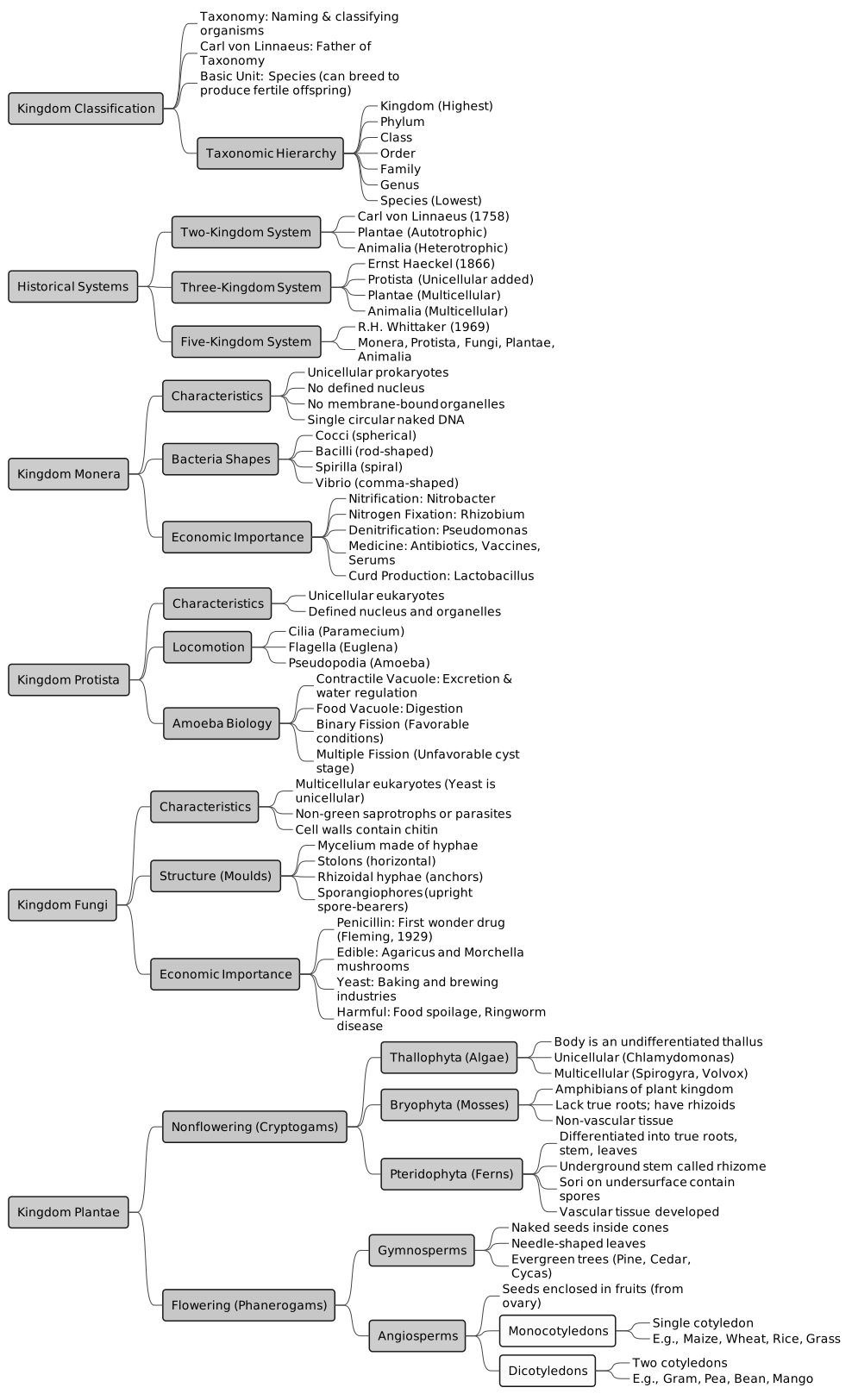
5. Comprehensive Chapter Mindmap
Want to print your doc?
This is not the way.
This is not the way.

Try clicking the ··· in the right corner or using a keyboard shortcut (
CtrlP
) instead.