Skip to content
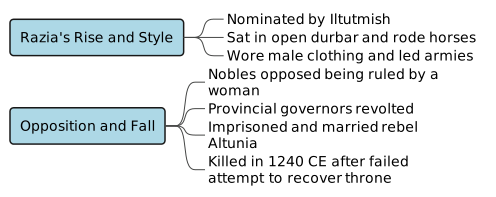
Razia Sultan was nominated by her father, Iltutmish, as his successor because of her bravery, intelligence, and just nature.The conservative Turkish nobles strongly disliked the idea of being ruled by a woman and initially placed her weak brother on the throne.Upon ascending, Razia defied traditional gender barriers by sitting in open durbar, wearing male attire, and leading armies into battle.This independent behavior angered the provincial governors, who rose in revolt and subsequently imprisoned her.Although she married the rebel leader Altunia in an attempt to recover the throne, their joint forces failed and both were killed in 1240 CE.
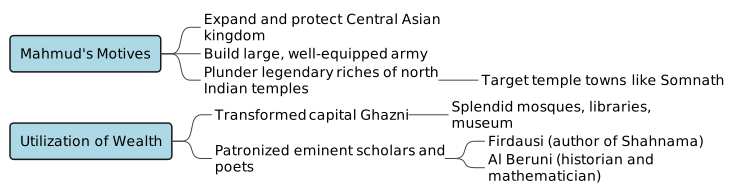
 Sultan Mahmud of Ghazni was an ambitious ruler who wanted to build a large and well-equipped army to expand and protect his Central Asian kingdom.To fulfill his military goals, he needed immense wealth, which attracted him to the legendary riches of the temples of north India.He invaded India 17 times over 25 years, plundering wealthy temple towns such as Somnath in Kathiawar.Instead of establishing an Indian empire, Mahmud used these treasures to transform his capital, Ghazni, into a magnificent city adorned with splendid mosques and libraries.He was a patron of learning who supported eminent scholars like the poet Firdausi and the historian Al Beruni.
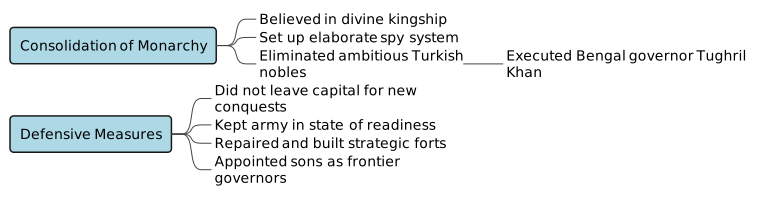
 Ghiyasuddin Balban consolidated his absolute monarchy by championing the theory of divine kingship, which positioned the king as God’s representative on earth.He enforced strict court discipline, set up an elaborate spy system, and ruthlessly crushed ambitious Turkish nobles, including the rebellious governor of Bengal.To protect the Sultanate from Mongol invasions, Balban chose not to leave the capital for new conquests and kept his army in constant readiness.He strengthened border defenses by repairing old forts, building new ones, and appointing his sons as governors of frontier provinces.These measures successfully replaced lawlessness with security, paving the way for agricultural development and economic prosperity.
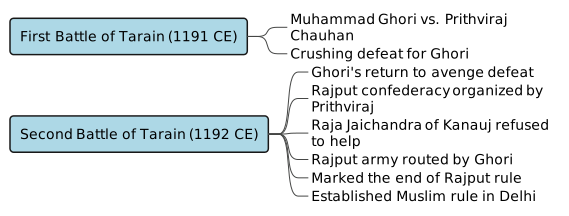
 In 1191 CE, Muhammad Ghori attacked the Rajput ruler Prithviraj Chauhan of Delhi and Ajmer, resulting in a crushing defeat for Ghori in the First Battle of Tarain.Ghori returned the following year to avenge this humiliation, prompting Prithviraj to organize a confederacy of Rajput chiefs.The powerful Raja Jaichandra of Kanauj refused to help, which severely weakened the Rajput defense.In the Second Battle of Tarain in 1192 CE, Ghori routed the Rajput army, paving the way for Muslim rule in Delhi.This decisive defeat marked the end of Rajput dominance in north India and established Delhi as a seat of Islamic power.
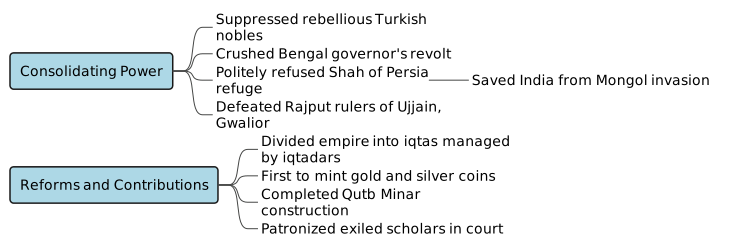
 Iltutmish consolidated his authority by suppressing challenging Turkish nobles and crushing the revolt of the Khilji governor of Bengal.He handled external threats masterfully, notably saving India from a Mongol invasion by politely refusing refuge to the fleeing Shah of Persia.By defeating Rajput rulers of Gwalior, Malwa, Ujjain, and Ranthambore, he successfully extended his control over the whole of north India up to the Narmada river.Administratively, he organized the finance and revenue departments and divided the empire into administrative provinces called iqtas managed by iqtadars.He was the first to mint gold and silver coins and completed the construction of the famous Qutb Minar.

Share
Explore
 Answer key
Prepared by: learnloophq@gmail.com
Chapter: 04. The Turkish Invasion And The Establishment Of The Delhi Sultanate
Answer Key & Explanatory Mindmaps
1. Discuss the challenges faced by Razia Sultan as a ruler and how her reign came to an end.
2. What were the primary motives of Mahmud of Ghazni’s invasions of India, and how did he utilize the wealth he plundered?
3. How did Ghiyasuddin Balban consolidate his power and defend his kingdom against the threat of Mongol invasions?
4. Explain the events and historical significance of the First and Second Battles of Tarain.
5. Describe the key achievements and administrative reforms introduced by Iltutmish during his reign.
Want to print your doc?
This is not the way.
This is not the way.

Try clicking the ··· in the right corner or using a keyboard shortcut (
CtrlP
) instead.