Skip to content
Whom did Jahangir send on an expedition to the Deccan to recapture the fort of Ahmadnagar?
(a) Prince Khusrau
(b) Prince Khurram
© Rana Amar Singh
(d) Malik AmbarWho was the English ambassador who met Emperor Jahangir in the early 17th century to secure trading rights?
(a) Nadir Shah
(b) Sher Afghan
© Sir Thomas Roe
(d) Rana Pratap SinghWhich of the following buildings is considered to be the most perfect of Shah Jahan’s architectural works?
(a) The Taj Mahal
(b) The Jama Masjid
© The Diwan-i-Khas
(d) The Moti MasjidIn which year did Shah Jahan shift his capital from Agra to Delhi?
(a) 1611 CE
(b) 1639 CE
© 1658 CE
(d) 1666 CEAfter the death of Rajaram, who took over the leadership of the Maratha resistance against Aurangzeb?
(a) Tarabai
(b) Sambhaji
© Shahu
(d) Shivaji
Nur Jahan’s original name before her marriage to Emperor Jahangir was _ _ _ _ _ _ _ _ _ _ _ _ _ _ .Because of his legendary patronage of architecture and building magnificent structures, Shah Jahan is known as the _ _ _ _ _ _ _ _ _ _ _ _ _ _ .One of Aurangzeb’s biggest administrative miscalculations was the reimposition of the _ _ _ _ _ _ _ _ _ _ _ _ _ _ and pilgrimage taxes on his Hindu subjects.Aurangzeb annexed the kingdom of Bijapur in 1686 CE and the kingdom of Golconda in _ _ _ _ _ _ _ _ _ _ _ _ _ _ .Shah Jahan’s magnificent golden throne, which took 7 years to complete, was taken away to Persia by _ _ _ _ _ _ _ _ _ _ _ _ _ _ in 1739 CE.
Jahangir allowed the defeated Rana Amar Singh of Mewar to retain his territory and appointed his son, Karna, as a military commander.The ceiling of the spectacular Diwan-i-Khas inside the Red Fort is made of pure gold.Aurangzeb spent the first half of his 50-year reign in the Deccan trying to crush the power of the Marathas.The Satnamis were a peace-loving sect of peasants, artisans, and traders who challenged the authority of Aurangzeb.Shah Jahan spent the last 8 years of his life as a prisoner in the Agra Fort, where he died in 1666 CE.
Jahangir : Salim :: Shah Jahan : _ _ _ _ _ _ _ _ _ _ _ _ _ _Taj Mahal : White Marble :: Red Fort : _ _ _ _ _ _ _ _ _ _ _ _ _ _1605 CE : Jahangir ascends the throne :: 1628 CE : _ _ _ _ _ _ _ _ _ _ _ _ _ _Mewar Resistance : Rana Amar Singh :: Maratha Resistance : _ _ _ _ _ _ _ _ _ _ _ _ _ _Nur Jahan : Light of the World :: Shah Jahan : _ _ _ _ _ _ _ _ _ _ _ _ _ _
Chain of JusticeShahjahanabadPeacock ThroneVirtual Ruler
Differentiate between the Early Reign and the Later Reign of Aurangzeb with respect to:Geographical focus of the EmperorMajor administrative or regional challenges faced
Why did Jahangir not face any major administrative problems in maintaining his empire during the first half of his reign?Who was Malik Ambar and what did he achieve in the Deccan during Jahangir’s reign?Why did the annexation of Bijapur and Golconda prove to be harmful to the Mughal Empire?State any two reasons for the decline of the Mughal Empire after the death of Aurangzeb.
Identify the monument shown in the illustration and name the city where it is located.Who built this grand monument and what was the name of the new capital city he established around it?Name two impressive buildings or structures situated inside the walls of this fort.
Why does Aurangzeb express that he has not been “the guardian and protector of the empire”? State his realization regarding his own rule.Which major military campaigns and policy decisions of Aurangzeb drained the empire’s resources, leading to this deep sorrow?Which emotion is the Emperor primarily expressing in this personal letter?
What actions can be taken against antisocial elements who damage our national monuments?Suggest two preventive measures that schools or local communities can adopt to protect and preserve this rich legacy for future generations.
The Influence of Nur Jahan:
Explain how Nur Jahan rose to power and discuss her extensive influence on the court, administration, and fashion during the reign of Jahangir.The Golden Age of Mughal Architecture:
Justify the statement that “Shah Jahan’s reign is the Golden Age of the Mughal Empire” by describing the architectural features of the Taj Mahal and the Moti Masjid.The Deccan Ulcer:
Some historians refer to Aurangzeb’s Deccan campaigns as the “Deccan ulcer”. Analyze how his attempts to crush the Maratha power failed and describe the long-term consequences of this campaign on the Mughal Empire.The Rise of Regional Powers:
Examine how the regional powers (such as the Marathas, Rajputs, and Sikhs) posed a severe threat to Aurangzeb’s authority and contributed to the disintegration of the Mughal Empire.

Share
Explore
 Question Paper
Prepared by: learnloophq@gmail.com
Chapter: 10. Jahangir Shah Jahan And Aurangzeb
PRACTICE EXAM: THE MUGHAL EMPIRE (JAHANGIR, SHAH JAHAN, AND AURANGZEB)
Grade Level: Middle School (History)
Time Allowed: 2 Hours
Max Marks: 80
SECTION A: OBJECTIVE TYPE QUESTIONS (25 Marks)
I. Multiple Choice Questions (MCQs)
(Select the most appropriate option) [1 × 5 = 5 Marks]
II. Fill in the Blanks
(Complete the sentences using _ _ _ _ _ _ _ _ _ _ _ _ _ _ for blanks) [1 × 5 = 5 Marks]
III. True or False
(State whether the following statements are True or False. Rewrite the false statements correctly) [2 × 5 = 10 Marks]
IV. Complete the Series
(Analyze the relationship in the first pair and complete the second pair) [1 × 5 = 5 Marks]
SECTION B: CONCEPTUAL & SHORT ANSWER QUESTIONS (20 Marks)
V. Explanation of Terms
(Explain the following terms in one or two sentences) [2 × 4 = 8 Marks]
VI. Differentiate Between Concepts
(Answer the following question in detail) [4 Marks]
VII. Short Answer Questions
(Answer the following questions in 2 to 3 sentences) [2 × 4 = 8 Marks]
SECTION C: SOURCE & OBSERVATION-BASED QUESTIONS (15 Marks)
VIII. Diagram-Based Question
A grand red sandstone fort with domes and minarets, flying the Indian national flag.
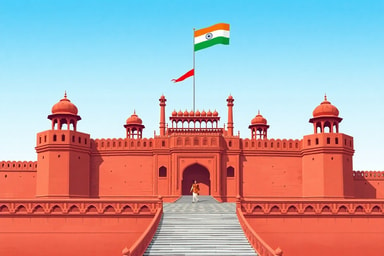
Based on the diagram and your knowledge, answer the following questions: [1 + 2 + 2 = 5 Marks]
IX. Source-Based Question
(Read the excerpt from one of Aurangzeb’s letters written during his final days and answer the questions that follow) [2 + 2 + 1 = 5 Marks]
“I know nothing of myself, what I am, and for what I am destined. The instant which passed in power, hath left only sorrow behind it. I have not been the guardian and protector of the empire. My valuable time has been passed vainly.”
X. Values and Life Skills (Observation Question)
(Read the passage and answer the questions) [5 Marks]
Our historical monuments are a vital part of our national heritage and belong to all citizens of India. However, we often observe some irresponsible people defacing, scratching, or disfiguring these national treasures.
SECTION D: LONG ANSWER QUESTIONS (20 Marks)
XI. Long Answer Questions
(Answer the following questions in detail, using bullet points where necessary) [5 × 4 = 20 Marks]
Want to print your doc?
This is not the way.
This is not the way.

Try clicking the ··· in the right corner or using a keyboard shortcut (
CtrlP
) instead.