Skip to content
Failed Schemes of Muhammad bin Tughlaq: Drained the state treasury, depleted resources, and severely hit agriculture and trade.Widespread Resentment: Misery, hardship, and high military casualties damaged the Sultan’s prestige and sparked revolts.Military and Foreign Policy Weakness: Firoz Shah Tughlaq lacked military command skills, demoralized the army with a weak foreign policy, and tolerated corruption and crime.Civil War: Firoz Shah’s death triggered a civil war among his descendants, leading provincial governors to declare independence.Foreign Invasion: Amir Timur, the Mongol ruler, invaded India (1398–99 CE) and plundered Delhi, dealing the final blow to the Tughlaq dynasty.Geographical Split: While North India faced political instability and turmoil, South India enjoyed over 200 years of stability and prosperity under two newly established independent kingdoms.
Establishment: Founded in 1336 CE by two brothers, Harihara I and Bukka Raya I, on the banks of the river Tungabhadra.Territory: Stretched from the Tungabhadra River to Cape Comorin.Duration: Ruled by 16 kings and lasted for approximately 230 years.
Military Success: The greatest ruler of the empire. He conquered the fertile Raichur Doab (the perennial region of conflict with the Bahmani kingdom) and made Vijayanagar the strongest military power in South India.Economy & Trade: Built dams and canals to boost agriculture. Promoted maritime trade with the Portuguese on the Malabar Coast, earning rich revenues through custom duties.Art & Literature: A Telugu poet, Sanskrit scholar, and generous patron of literature.Architecture: Built legendary temples, including the Vithalaswami Temple and the Hazar Rama Temple.
Weak and incompetent successors followed Krishnadeva Raya.In 1565 CE, during the reign of Rama Raya, a combined alliance of five Deccan sultanates (Bijapur, Ahmadnagar, Berar, Golconda, and Bidar) defeated Vijayanagar in the Battle of Talikota.The capital city of Vijayanagar was plundered, burned, and ruined. The kingdom lingered until the early 17th century but never regained its former glory.
Revenue: Primarily generated from trade taxes and land taxes (ranging from 1/3 to 1/6 of the produce, based on assessed soil quality).Imports: Arabian horses, Chinese silks, and Sri Lankan elephants.Exports: Cotton cloth, sandalwood, rice, sugar, and spices.
Social Order: Rigid caste system where Brahmanas held immense power. Society was highly conservative and governed by Vedic customs.Women: Generally respected but enjoyed little freedom. Practices of child marriage and sati were common, though some upper-class women held high political and literary roles.Religious Tolerance: Staunch Hindus who practiced broad tolerance. They employed Muslims in the army and administration, maintaining equality among Hindus, Muslims, Christians, and Jews.Hampi Capital City: Developed as a magnificent holy city (tirth) protected by seven concentric walls spanning a 96-km circumference. Known for crowded bazaars where diamonds, rubies, pearls, and emeralds were sold openly.Sources of History: Foreign travelogues by Domingo Paes (Portugal) and Abdur Razzaq (Persia) provide rich details on the kingdom’s architecture, markets, and irrigation systems.
Establishment: Founded in 1347 CE by Alauddin Hassan (who took the title Alauddin Bahman Shah), an official of the Delhi Sultanate, during the reign of Muhammad bin Tughlaq.Territory: Spanned from the Arabian Sea in the west to the Bay of Bengal in the east. It covered the northern Deccan, with the Krishna River marking its southern boundary.
The fertile land mass between the Krishna River and Tungabhadra River was highly prized for its revenue.It became a perpetual battleground, constantly changing hands between the Vijayanagar and Bahmani kingdoms until Vijayanagar’s final defeat in 1565 CE.
Military Achievements: Captured the major port of Goa from the Vijayanagar kingdom and expanded the boundaries of the state.Administration & Economy: Boosted agricultural policies, making the kingdom economically prosperous.Patron of Learning: Built a grand madrasa (college) in Bidar, gave scholarships to needy students, and donated his personal library of 3,000 books.Personal Life: Lived a highly spartan life, sleeping on a mat and eating out of earthen vessels.Downfall: Internal noble rivalry between the local Deccanis and the foreign Pardesis (Gawan was a Pardesi) led to a conspiracy. The Sultan ordered his execution, signaling the beginning of the end for the Bahmani Kingdom.
BerarBijapurBidarAhmadnagarGolconda
The King: Absolute in theory, but heavily dependent on the military. Weak sultans were dominated by nobles and ulemas.Provinces: Governed by powerful provincial governors who collected revenue and supplied military troops during wars.Cultural Focus: Islamic patronage. Court languages were Persian and Arabic. Built numerous mosques, madrasas, and libraries in the capital cities of Gulbarga and Bidar.
Jami Masjid: Located at Gulbarga.Chand Minar: Located at Daulatabad.Gol Gumbaz (Bijapur): The tomb of Adil Shah of Bijapur.Features the second largest whispering dome in the world (after St. Peter’s Basilica).Stands unsupported by any pillars, using a combination of intersecting arches and a cubic base structure with corner minarets.The whispering gallery is 33 meters above the pavement; even the faintest whisper echoes nine times around the dome.

Share
Explore
 Recap Hub
Prepared by: learnloophq@gmail.com
Chapter: 07. Rise Of The Vijayanagar And Bahmani Kingdoms
Theme 4: The Vijayanagar and Bahmani Kingdoms
Part 1: Disintegration of the Delhi Sultanate
The Tughlaq dynasty sowed the seeds of its own destruction, leading to the collapse of the Delhi Sultanate and the rise of independent Deccan kingdoms.
Causes of Disintegration
Part 2: The Vijayanagar Kingdom (1336 CE – Early 17th Century CE)
Foundation and Extent
Krishnadeva Raya (1509–1530 CE)
The Decline and Battle of Talikota (1565 CE)
Part 3: Achievements & Life in the Vijayanagar Kingdom
Administrative Structure
Administrative Level
Governed By
Key Features
Central Government
The King & Council of Ministers
The king was absolute, viewed as God’s representative, and his word was law.
Provincial Government
Governors
Empire divided into 6 provinces (rajya or mandalam).
District Level
Appointed Officials
Provinces were subdivided into districts (nadu).
Village Level
Hereditary Officers
Bottom of the ladder (grama), run on a revived feudal system.
Economy and Trade
Society, Religion, and Culture
Part 4: The Bahmani Kingdom (1347 CE – 1527 CE)
Foundation and Extent
The Raichur Doab Conflict
Mahmud Gawan (Wazir / Prime Minister)
Disintegration (1527 CE)
Following Gawan’s death, the kingdom fractured into five independent sultanates by 1527 CE:
These states fought constantly but united briefly to defeat Vijayanagar in 1565 CE. Their subsequent mutual warfare made them easy targets for the Mughal Empire.
Part 5: Achievements & Architecture of the Bahmani Kingdom
Administration & Religion
Architectural Masterpieces
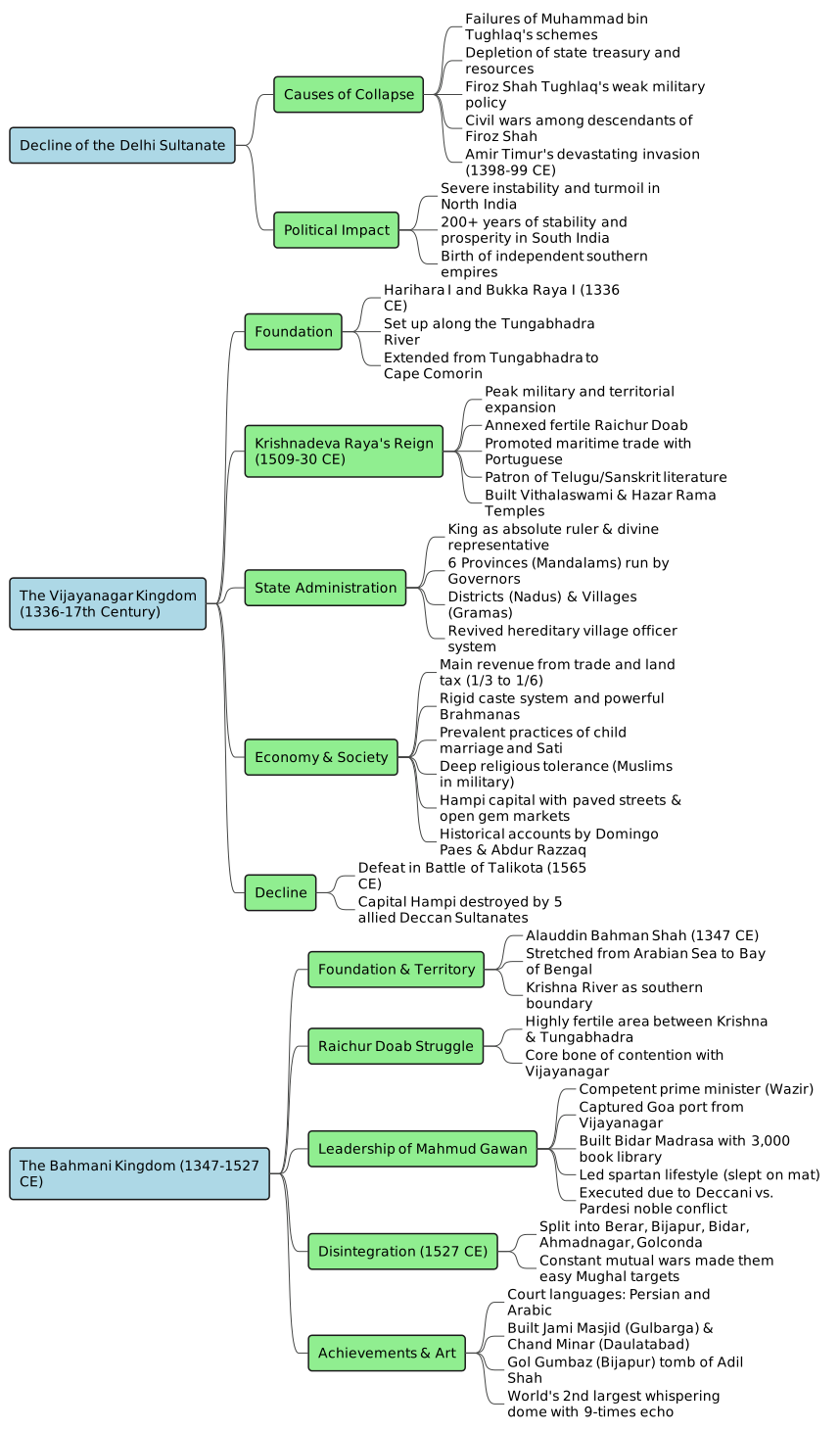
Chapter Mindmap
Want to print your doc?
This is not the way.
This is not the way.

Try clicking the ··· in the right corner or using a keyboard shortcut (
CtrlP
) instead.