Skip to content
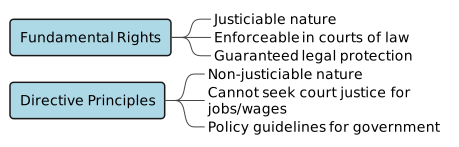
While both Fundamental Rights and Directive Principles share the common purpose of protecting citizen rights and promoting national progress, they differ significantly in their legal nature. Fundamental Rights are justiciable, meaning that if citizens are deprived of these rights, they can directly approach a court of law to seek enforcement and protection. In contrast, Directive Principles of State Policy are non-justiciable, meaning they cannot be legally enforced in a court of law if they are not met. For example, an individual cannot sue the government in court if they fail to secure a job or receive proper wages. Additionally, while Fundamental Rights are legally binding guarantees, Directive Principles act as guiding policies for governments to implement over time.
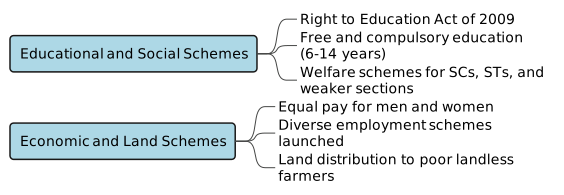
Governments have made sincere efforts to implement several Directive Principles through various laws, welfare schemes, and development initiatives. A major achievement is the Right to Education Act of 2009, which made free and compulsory education for children between 6 and 14 years a Fundamental Right. Additionally, the central and state governments have implemented numerous welfare schemes targeted at Scheduled Castes, Scheduled Tribes, and other weaker sections of society. To promote economic equality, laws have been enacted to ensure equal pay for both men and women, alongside the launch of diverse employment schemes. Furthermore, land reform laws have been passed to distribute land among poor landless farmers to address economic inequality.
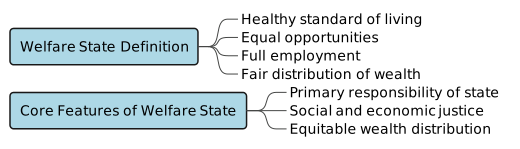
A welfare state is a country where citizens are guaranteed a healthy standard of living, equal opportunities, full employment, and a fair distribution of wealth. In such a state, the welfare of citizens is the primary responsibility of the government, and every individual enjoys social and economic justice. It is built on the core principle of providing equal opportunities for all while aiming to achieve full employment. Furthermore, a welfare state guarantees an equitable distribution of wealth among its people to prevent extreme economic disparities. Sincere efforts and cooperation between the government and the people are essential to fully realize this ideal.
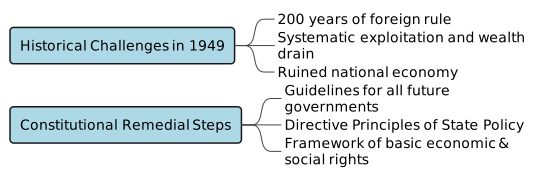
The framers of the Constitution were unable to establish a welfare state in 1949 because India had just gained independence from 200 years of foreign rule. This prolonged British rule had systematically exploited and drained India’s wealth, leaving the economy completely ruined. Recognizing that the newly formed government lacked the resources to immediately guarantee all economic and social rights, they decided to lay down guidelines for future governance. These guidelines, known as the Directive Principles of State Policy, were incorporated into the Constitution to guide central, state, and local governments. They serve as a roadmap containing basic economic and social rights that every Indian should eventually enjoy.
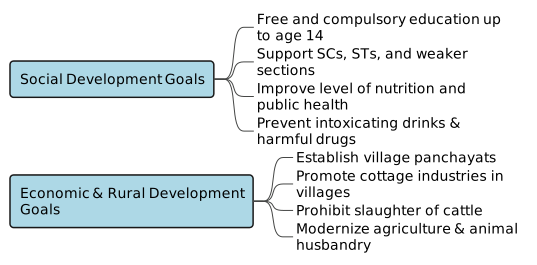
Gandhian Principles are a category of Directive Principles inspired by Mahatma Gandhi’s plans for social and economic development during the freedom movement. Under these principles, the government is directed to take specific steps like establishing village panchayats and promoting cottage industries in rural areas. They also focus on educational and economic advancement by directing the state to provide free and compulsory education for children up to the age of 14. Furthermore, these guidelines aim to protect the weaker sections, specifically the Scheduled Castes and Scheduled Tribes, while improving public health and nutrition. Finally, they direct the prohibition of slaughtering cattle and prevent the consumption of intoxicating drinks and harmful drugs.

Share
Explore
 Answer key
Prepared by: learnloophq@gmail.com
Chapter: 13. Directive Principles Of State Policy
Question 1: How do Fundamental Rights differ from the Directive Principles of State Policy?
Question 2: Describe some of the measures taken by governments to implement the Directive Principles of State Policy.
Question 3: What is a welfare state, and what are its key features?
Question 4: Why did the framers of the Constitution of India not establish a welfare state immediately in 1949, and what steps did they take instead?
Question 5: Explain the Gandhian Principles included in the Directive Principles of State Policy and provide examples of how they promote development.
Want to print your doc?
This is not the way.
This is not the way.

Try clicking the ··· in the right corner or using a keyboard shortcut (
CtrlP
) instead.