Skip to content
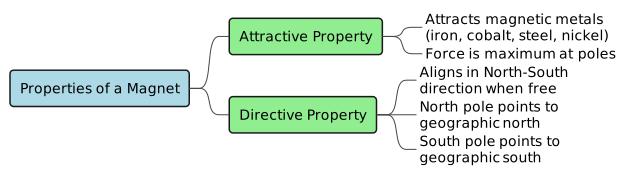
Explain the attractive and directive properties of a magnet.The attractive property of a magnet states that it attracts magnetic materials like iron, cobalt, steel, and nickel, with this magnetic force being maximum at its poles. Meanwhile, the directive property means that a freely suspended magnet will always align itself along the Earth’s geographic north-south direction. The specific end of the magnet pointing towards the geographic north is named the north pole, whereas the end pointing to the geographic south is the south pole. These dual properties allow magnets to interact selectively with certain metals and serve as reliable orientation tools.
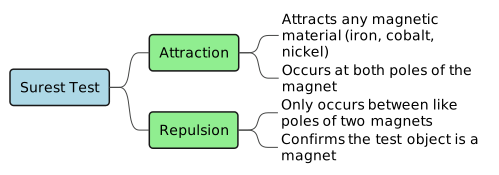
 Why is repulsion considered the surest test of magnetism?Repulsion is considered the surest test of magnetism because an ordinary, unmagnetized magnetic material like an iron bar is attracted to both poles of a magnet. If the material under test is actually a magnet itself, only one of its ends will be attracted, while the other end will experience repulsion. This phenomenon occurs because like magnetic poles repel each other, whereas opposite poles attract. Therefore, a simple attraction test cannot differentiate between a magnet and a magnetic material, making repulsion the only definitive confirmation of magnetism.
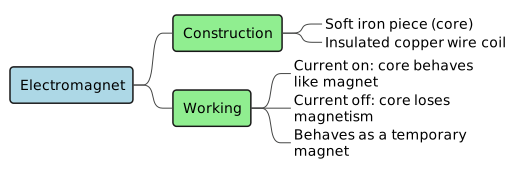
 Describe the construction and basic working of a temporary electromagnet.A temporary electromagnet is constructed by winding an insulated copper wire into a coil around a soft iron piece called the core. When an electric current is passed through this wire coil, the soft iron core behaves like a magnet and gains magnetic properties. However, as soon as the electric current is stopped, the soft iron core immediately loses its magnetism. This makes the electromagnet a temporary magnet that only retains its magnetic force while an electric current is active in the circuit.
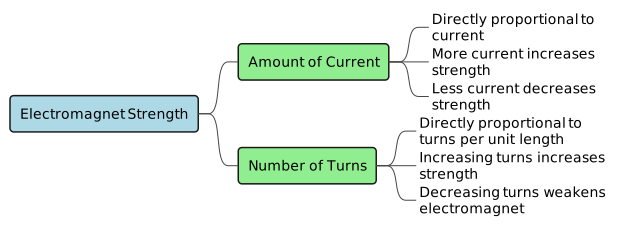
 Detail the factors that affect the strength of an electromagnet.The strength of an electromagnet depends directly on the amount of current flowing through the coil and the number of turns per unit length. Firstly, the magnetic strength is directly proportional to the electric current, meaning the electromagnet becomes stronger as the current increases and weaker as it decreases. Secondly, the strength is directly proportional to the number of turns of the coil wrapped around the core. Increasing the density of these turns increases the overall magnetic strength, whereas having fewer turns results in a weaker electromagnet.
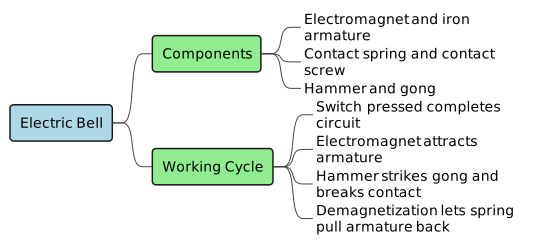
 Detail the construction and working mechanism of an electric bell.An electric bell consists of an electromagnet, a contact spring, a contact screw, an iron armature, a hammer, and a gong fitted on a board. When the push button switch is pressed, current flows through the circuit, magnetizing the electromagnet which then attracts the armature. This movement causes the hammer to strike the gong to produce a ringing sound, but it also breaks the circuit at the contact screw. Once the circuit is broken, the electromagnet loses its magnetism, allowing the spring to pull the armature back to its original position to repeat the cycle.
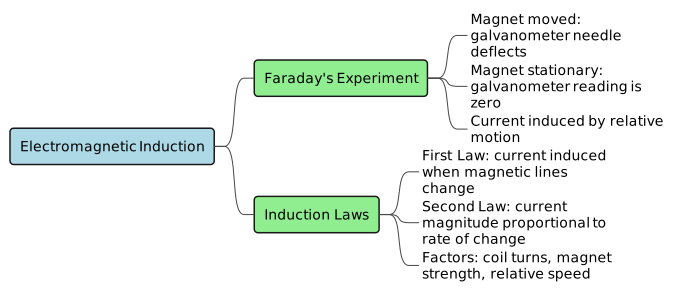
 Explain Faraday’s experiment and the laws of electromagnetic induction.In Faraday’s experiment, a sensitive galvanometer is connected to a coil of insulated copper wire to detect any flow of electric current. When a bar magnet is moved towards or away from the coil, the galvanometer needle deflects, demonstrating that current is induced due to relative motion. This process is governed by two laws, starting with the first law which states that current is induced when the number of magnetic lines of force associated with a coil changes. The second law establishes that the magnitude of this induced current is directly proportional to the rate at which those magnetic lines of force change.

Share
Explore
 Long Answers
Prepared by: learnloophq@gmail.com
Chapter: 08. Magnetism
Want to print your doc?
This is not the way.
This is not the way.

Try clicking the ··· in the right corner or using a keyboard shortcut (
CtrlP
) instead.