Skip to content
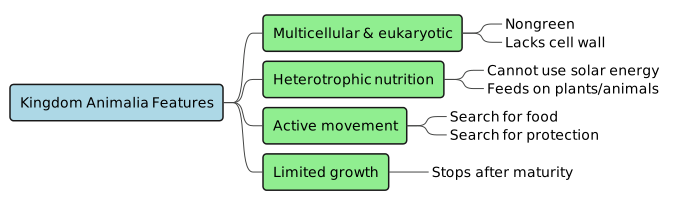
Kingdom Animalia consists of multicellular, nongreen eukaryotes that lack a cell wall. They are heterotrophic organisms, meaning they cannot use solar energy to make their own food and must feed on plants, animals, or both. Most animals move from place to place in search of food and protection. Additionally, they exhibit limited growth that completely stops once they reach maturity.
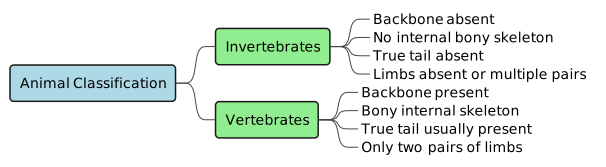
Invertebrates and vertebrates show distinct anatomical differences. Invertebrates lack a backbone and an internal skeleton of bones, whereas vertebrates possess both of these structures. Additionally, vertebrates typically have a true tail and only two pairs of limbs. In contrast, invertebrates do not have a true tail, and their limbs are either absent or occur in three, four, or many pairs.
The earthworm is called the farmer’s friend because its burrowing and feeding habits make the soil porous, which increases aeration, water absorption, and fertility. In contrast, flatworms like the tapeworm are parasites that live inside the host’s body and lack a true body cavity. For instance, a tapeworm can reach up to 5 meters in length and looks like a long ribbon with a small head. Its body segments directly absorb digested food from the host’s intestine.

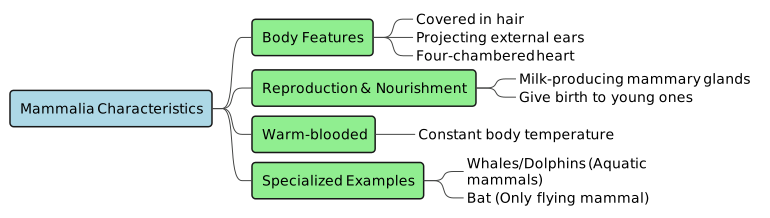
Mammals are warm-blooded animals with a four-chambered heart whose bodies are covered with hair. They possess projecting external ears, and females have milk-producing mammary glands to nourish their young ones. Whales and dolphins are classified as mammals rather than fish despite living in water. Furthermore, bats are classified as mammals because they are the only flying mammals that share these unique characteristic features.
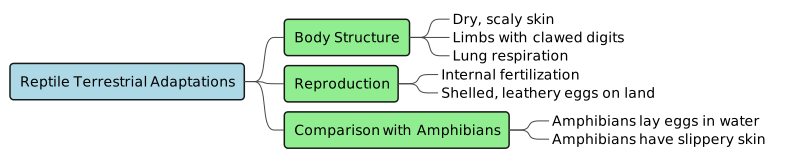
Reptiles are land vertebrates with dry, scaly skin that breathe through lungs and possess a three-chambered heart. Unlike amphibians who must lay their eggs in water, reptiles lay large, leathery, and yolky eggs on dry land. Their eggs are fertilized internally inside the female’s body, which is a major adaptation for terrestrial survival. Additionally, reptiles have limbs with digits ending in claws to help them move effectively on land.

Share
Explore
 Long Answers
Prepared by: learnloophq@gmail.com
Chapter: 03. Kingdom Animalia
Question 1
Question 2
Question 3
Question 4
Question 5
Want to print your doc?
This is not the way.
This is not the way.

Try clicking the ··· in the right corner or using a keyboard shortcut (
CtrlP
) instead.