Skip to content
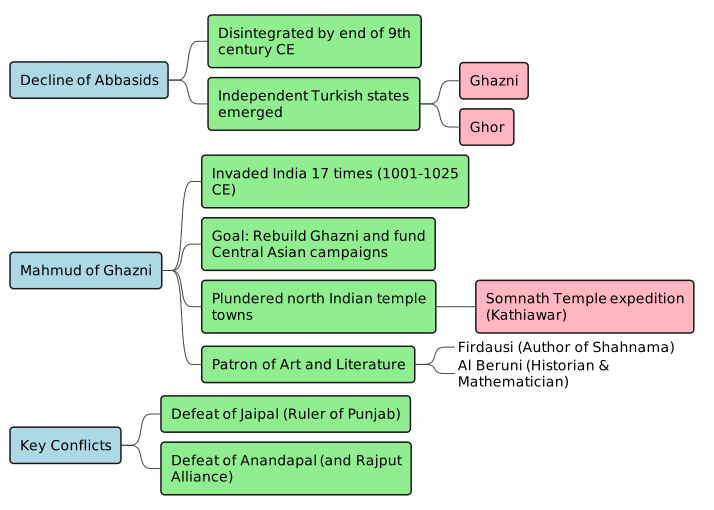
Decline of the Abbasid Caliphate: The brilliant cultural vitality of the Abbasid Caliphate during the 8th and 9th centuries CE declined politically by the end of the 9th century CE.Disintegration: The once mighty Abbasid empire broke apart into several independent states ruled by the Turks, who had previously served in the Caliphs’ armies.Ghazni and Ghor: These were the two most prominent independent states established by the Turks in Central Asia.
Ambition & Motivation: Mahmud was an ambitious ruler who wanted to build a large, well-equipped army to expand his Central Asian kingdom and protect it from rival states.Targeting Indian Riches: To fund his military ambitions, Mahmud was attracted to the fabulous treasures stored in the temple towns of northern India.State of Northern India: At the time of his invasions, northern India was highly divided. The Rajput rulers were locked in mutual rivalries and failed to present a united front against foreign invaders. In total, Mahmud invaded India 17 times over a span of 25 years.
War against Jaipal: Mahmud first defeated Jaipal, the Hindu ruler of Punjab, whose kingdom stretched from Punjab to modern-day Afghanistan. Jaipal was forced to pay tribute. Overwhelmed by the humiliation of this defeat, Jaipal immolated himself on a funeral pyre.War against Anandapal: Jaipal’s son, Anandapal, organized a confederacy of western and central Indian rulers to resist the Turks. The invasion inspired a mass defensive movement—even local women sold their jewelry and melted their gold to contribute to the war effort. However, Anandapal and his allies were ultimately defeated, opening the door for deeper Turkish raids into mainland India.Targeting Temple Towns: Mahmud focused his later attacks on north Indian temple towns, which functioned as major economic treasure houses.The Somnath Temple Expedition (Kathiawar): This was Mahmud’s most famous and lucrative raid. Despite a stubborn defense by 50,000 Hindu soldiers who fought for three days to save the sacred temple, the defenders were defeated. Mahmud plundered the temple’s vast wealth and returned to Ghazni.
Territorial Annexation: Mahmud was not interested in establishing an empire in India. Punjab was the only Indian province he annexed to his kingdom.Transforming Ghazni: He channeled India’s plundered wealth to rebuild his capital, Ghazni, decorating it with splendid mosques, libraries, a museum, and a glittering court filled with pearls, rubies, and diamonds.Historical Dual Image: While remembered as an “idol breaker” and large-scale bandit in Indian history, he was a great patron of art and literature in Central Asia. His court patronized:Firdausi: The legendary Persian poet who authored the epic Shahnama (the biography of Mahmud).Al Beruni: The famous Persian historian and mathematician.Aftermath: Following Mahmud’s death, the Ghazni empire disintegrated quickly. Northern India remained free from foreign invasions for the next 150 years.
The Rathors of KanaujThe Chauhans of Delhi and AjmerThe Solankis of GujaratThe Paramaras of MalwaThe Chandellas of Bundelkhand
Suryavamsi (solar lineage)Chandravamsi (lunar lineage)Agnikula (fire lineage)
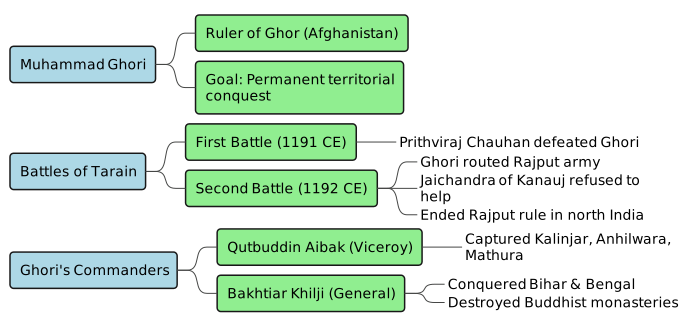
End of Rajput Hegemony: The defeat of Prithviraj Chauhan marked the end of Rajput rule in northern India.Founding of Muslim Rule: The kingdom of Delhi fell into the hands of Muslim rulers, who occupied the throne of Delhi from that point until 1858.HOTS Analysis: If Raja Jaichandra had set aside his rivalries and assisted Prithviraj during the Second Battle of Tarain, the unified Rajput forces might have successfully repelled Ghori, changing the entire political history of medieval India.
Annexation of Kanauj (1194 CE): Two years after Tarain, Ghori defeated and killed Raja Jaichandra, annexing his territories.The Viceroyalty of Qutbuddin Aibak: Ghori appointed his trusted slave and general, Qutbuddin Aibak, as his viceroy in India before returning to Ghor. Aibak expanded Ghori’s empire by capturing the forts of Kalinjar (Bundelkhand) and Anhilwara (Gujarat), and extending control over Mathura, Gwalior, and Malwa.The Bengal Campaign: Another of Ghori’s generals, Muhammad bin Bakhtiar Khilji, swept through Bihar and overthrew the Sena dynasty of Bengal.During this campaign, Khilji’s forces destroyed Buddhist monasteries and libraries. This dealt a death blow to Buddhism in India, forcing surviving monks to flee to Tibet with their manuscripts.
While Ghori was neither as brilliant a military leader nor as active a patron of arts as Mahmud, historians regard him as the true founder of the Turkish kingdom in India because he systematically annexed territories and established a permanent capital at Delhi.
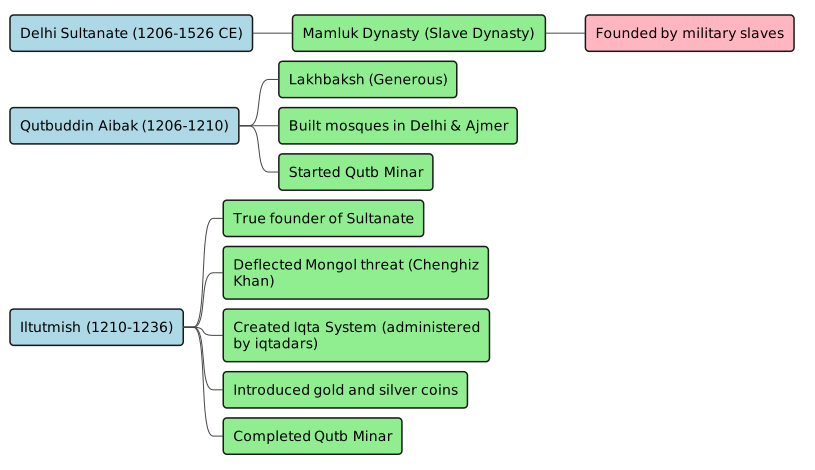
Generosity: Known as Lakhbaksh (“giver of lakhs”) due to his charitable nature. Court historians describe him as a just ruler who treated his Hindu subjects well.Iconoclasm: He dismantled several ancient temples to acquire building materials for Islamic monuments.Architectural Contributions:Built two major mosques: one in Delhi and one in Ajmer.Started the construction of the Qutb Minar in Delhi, which was designed to be used by the muezzin to call Muslims to prayer.Death: Died in 1210 CE from an accidental fall from his horse while playing polo.
Consolidation: He suppressed the challenging Turkish nobles, crushed the rebellion of the Khilji governor of Bengal, and neutralized rivals in Ghazni and Multan.Deflection of the Mongol Threat: When the Mongol chief Chenghiz Khan reached the borders of India pursuing the fleeing Shah of Persia, Iltutmish politely refused to grant the Shah asylum. This diplomatic maneuver saved the young Delhi Sultanate from a devastating Mongol invasion.Territorial Integration: He defeated the Rajput rulers of Ujjain, Ranthambore, Malwa, and Gwalior, extending the Sultanate’s control up to the Narmada River.Sovereign Recognition: He secured official recognition as the sovereign of India from the Caliph of Baghdad.The Iqta System: He reorganized the revenue and administrative departments by dividing the empire into provinces called iqtas. Each iqta was administered by an officer called an iqtadar, who collected land revenue and maintained local law and order.Currency Reforms: He was the first Sultan to introduce standard gold and silver coins.Architectural Completion: He completed the construction of the Qutb Minar and built his own red sandstone tomb in Delhi.
Founder and first ‘Khan’ of the Mongol Empire (ruling from 1206 to 1227 CE).Unified the Mongol tribes and launched sweeping military campaigns, conquering large parts of China and Central Asia.Created the largest contiguous land empire in human history and is revered as the founding father of Mongolia.
Opposition by Nobles: The conservative Turkish nobles rejected the idea of being ruled by a woman. Instead, they crowned Prince Rukhnuddin Firoz Shah (Iltutmish’s son).Deposition of Rukhnuddin: Rukhnuddin proved to be a pleasure-loving, worthless ruler. After a chaotic reign of only 7 months, he was deposed, and Razia ascended the throne.
Qualities: Razia was brave, highly intelligent, and just.Defying Traditions: She sat in the open court (durbar) to conduct state business, abandoned traditional female attire to dress like a man, rode horses, and personally led her armies into battle.Welfare Focus: She held the welfare of her subjects as her primary royal duty.
The Nobles’ Revolt: The provincial governors, uncomfortable with her authority, rose in open revolt against her.Defeat & Imprisonment: Razia tried to crush the rebellion but was defeated and imprisoned by the rebel leader, Altunia.Marriage for Survival: She managed to win over Altunia by marrying him. Together, they attempted to march on Delhi to recover the throne but failed. Both were killed in 1240 CE.
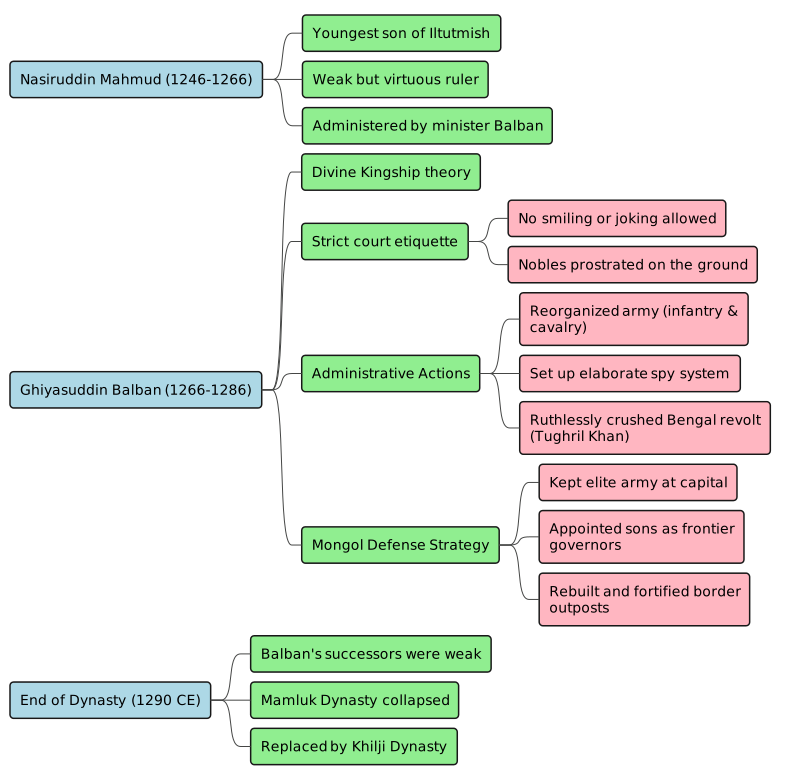
Divine Representative: Balban strongly believed in divine kingship—the belief that the king is God’s representative on Earth.Strict Court Discipline: He maintained absolute gravity: he never smiled and banned laughing, joking, or lighthearted conversation in his court.Prostration: Nobles were forced to show absolute submission by kneeling and touching their foreheads to the ground in front of him.
Absolute Monarchy: Balban systematically stripped the Turkish nobles of their power and ruthlessly executed challengers to make the monarchy supreme and all-powerful.Military Reorganization: Strengthened the army by expanding and upgrading both the infantry and the cavalry.Strategic Fortification: Erected strong forts in key locations to maintain defense.Espionage: Set up an elaborate, highly efficient spy network to monitor nobles and secure intelligence.Law & Order: Ruthlessly suppressed local robber tribes who preyed on travelers, restoring safety and stability.Bengal Rebellion: When the governor of Bengal, Tughril Khan, revolted, Balban (at the age of 70) personally marched to Bengal, defeating him and executing Tughril, his family, and all supporters.
Appointing his own capable sons as governors of key frontier provinces.Constructing new forts and reinforcing old ones along invasion routes.Keeping the army in a constant state of battle readiness.
Abbasid Caliphate: A highly cultured Islamic empire ruling parts of the Middle East and Central Asia during the 8th and 9th centuries CE, which disintegrated into independent Turkish states by the late 9th century.Sultans: The sovereign rulers of the Delhi Sultanate who administered their territories from their central capital, Delhi.Shahnama: The monumental epic poem and biography written by the Persian poet Firdausi, detailing the life and achievements of Sultan Mahmud of Ghazni.Lakhbaksh: Meaning “giver of lakhs,” this title was given to Qutbuddin Aibak by court historians to honor his immense generosity and public charity.Muezzin: A designated official who calls Muslims to daily prayers, traditionally from the balcony of a mosque’s minaret (such as the Qutb Minar).Iqtas: Administrative provinces of the Delhi Sultanate introduced during Iltutmish’s reign.Iqtadar: A noble or military officer appointed by the Sultan to administer an iqta, collect land revenues, and maintain local law and order.Divine Kingship: The political theory adopted by Balban stating that the king is God’s direct representative on Earth, making his authority absolute and unquestionable.

Share
Explore
 Self Study
Prepared by: learnloophq@gmail.com
Chapter: 04. The Turkish Invasion And The Establishment Of The Delhi Sultanate
The Turkish Invasion and the Establishment of the Delhi Sultanate
1. The Turkish Invasion: Mahmud of Ghazni
Rise of the Turkish States
Sultan Mahmud of Ghazni (Reign: 1001–1025 CE)
Major Invasions and Campaigns

Legacy and Patronage
2. Muhammad Ghori and the Conquest of India
In the late 12th century CE, the kingdom of Ghor (located in north-western Afghanistan near Ghazni) rose to power. Its ruler, Muhammad Ghori, launched campaigns to conquer India and enrich his kingdom with its wealth.

Political Landscape of Northern India
When Ghori invaded, northern India was ruled by five major Rajput kingdoms:
Knowledge of India: Rajput Lineage
Rajput royal families historically linked their lineage to three legendary origins:
The Battles of Tarain
Battle
Year
Combatants
Key Events & Outcomes
First Battle of Tarain
1191 CE
Muhammad Ghori vs. Prithviraj Chauhan
Prithviraj Chauhan, the ruler of Delhi and Ajmer, inflicted a crushing defeat on Ghori, who fled back to Ghor to recoup.
Second Battle of Tarain
1192 CE
Muhammad Ghori vs. Prithviraj Chauhan
Ghori returned with a stronger army. Prithviraj organized a Rajput confederacy, but his powerful rival Raja Jaichandra of Kanauj refused to join. Ghori routed the Rajput forces.
Impact of Ghori’s Victory
Further Conquests and Expansion
Ghori vs. Mahmud of Ghazni
3. The Delhi Sultanate and the Early Mamluk Dynasty
The period from 1206 to 1526 CE is known as the era of the Delhi Sultanate because its rulers were styled as Sultans and ruled from their capital city, Delhi.
Following Ghori’s death in 1206 CE without heirs, his viceroys declared independence. Qutbuddin Aibak took control of Ghori’s Indian possessions, establishing the Mamluk Dynasty (also called the Slave Dynasty, as its early rulers rose from military slavery to sovereign power through merit).

Qutbuddin Aibak (Reign: 1206–1210 CE)
Shamsuddin Iltutmish (Reign: 1210–1236 CE)
Following a brief, unstable transition after Aibak’s death, Aibak’s capable son-in-law, Iltutmish, ascended the throne. He is widely regarded as the true founder of the Delhi Sultanate.
Administrative and Military Achievements of Iltutmish
Biography: Chenghiz Khan (1162–1227 CE)
4. Razia Sultan: The Reign of a Female Monarch
Before his death, Iltutmish nominated his intelligent daughter, Razia Sultan, as his successor, believing none of his sons were capable of ruling.

Sidetracking and Ascension (Reign: 1236–1240 CE)
Leadership and Administration
Rebellion and Demise
Did You Know? The Legend of Razia, Yakut, and Altunia
Razia Sultan remains a highly romanticized figure in history. According to accounts, she was in love with her Abyssinian slave, Yakut. Altunia, her childhood friend, was allegedly in love with her and launched his rebellion out of jealousy. After Yakut was murdered and Razia was captured, she agreed to marry Altunia to save her life and regain her throne.
Sustainable Development Goals (SDGs): Goal 5 – Gender Equality
Razia’s reign highlights how early institutional gender bias cut short the career of a highly capable ruler. In contemporary times, the global focus on Gender Equality (SDG 5) aims to dismantle such systemic barriers, ensuring equal opportunities for women to lead, learn, and grow without prejudice.
5. Ghiyasuddin Balban and the End of the Mamluk Dynasty
Following Razia’s death, the Sultanate suffered six years of intense political instability. In 1246 CE, the nobles crowned Nasiruddin Mahmud (1246–1266 CE), the youngest son of Iltutmish. Nasiruddin was virtuous but weak and inexperienced, leaving his powerful minister, Ghiyasuddin Balban, to run the affairs of the state.

Ghiyasuddin Balban (Reign: 1266–1286 CE)
Following Nasiruddin’s death in 1266 CE, Balban formally ascended the throne. An experienced, highly capable, and iron-fisted ruler, he dominated the Sultanate for twenty years.
Theory of Divine Kingship and Court Etiquette
Major Reforms and Consolidation Measures
Defense Against the Mongol Threat
Balban never left his capital city to conquer new Indian territories, keeping his elite forces centralized to counter potential Mongol invasions. His defensive strategy included:
Decline of the Mamluk Dynasty
The peace, security, and stability established by Balban fostered agricultural growth, trade, and economic prosperity. However, upon his death in 1286 CE, his successors proved weak and incompetent. Within four years, in 1290 CE, the Mamluk Dynasty came to an end, and control of the Delhi Sultanate passed to the Khilji Dynasty.
6. Comprehensive Summary of the Mamluk Rulers
The following table summarizes the key milestones, administrative contributions, and historical events of the Mamluk Dynasty:
Sultan
Reign
Administrative Reforms
Key Military Events
Major Monuments
Qutbuddin Aibak
1206–1210 CE
Laid foundation of Delhi Sultanate; ruled as viceroy, then Sultan.
Captured Kalinjar, Anhilwara, Mathura, and Gwalior.
Started Qutb Minar; built mosques in Delhi & Ajmer.
Shamsuddin Iltutmish
1210–1236 CE
Created the Iqta system run by iqtadars; minted first standard gold and silver coins.
Defeated Rajput rulers; crushed Bengal revolt; diplomatic avoidance of Chenghiz Khan’s Mongols.
Completed the Qutb Minar; built his own red sandstone tomb.
Rukhnuddin Firoz Shah
1236 CE
None (deposed due to incompetence).
Deposed by nobles after 7 months of misrule.
None.
Razia Sultan
1236–1240 CE
Administered open court; prioritized public welfare.
Defeated by rebel Altunia; subsequent joint military campaign to recover Delhi failed.
None.
Nasiruddin Mahmud
1246–1266 CE
Weak governance; power delegated to Ghiyasuddin Balban.
Kept external threats at bay under Balban’s guidance.
None.
Ghiyasuddin Balban
1266–1286 CE
Absolute monarchy; implemented divine kingship theory; set up elaborate spy networks.
Suppressed the Bengal rebellion of Tughril Khan; executed local robber bands; constructed a northern border defense against Mongols.
Built strategically located military forts.
7. Key Terms and Concepts
Want to print your doc?
This is not the way.
This is not the way.

Try clicking the ··· in the right corner or using a keyboard shortcut (
CtrlP
) instead.