Skip to content
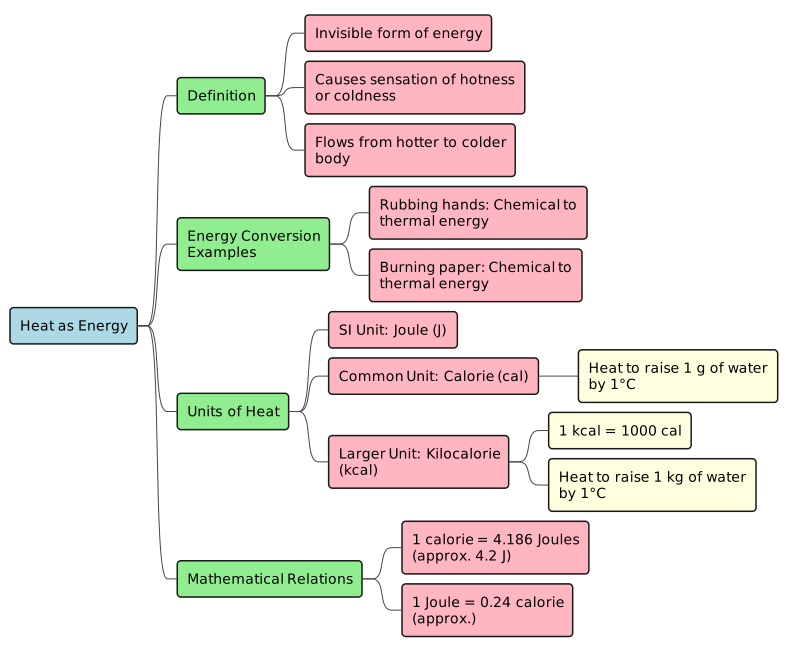
Definition of Heat:Heat is an invisible form of energy that flows from a hotter body to a colder body.It is produced when atoms and molecules in a body receive energy and start moving or vibrating rapidly.We cannot see heat energy, but we can feel its effects as the sensation of hotness or coldness.Examples of Energy Conversion to Heat:Rubbing hands: Frictional force converts the chemical energy stored in our hands into thermal (heat) energy, causing molecules in our palms to move faster and produce warmth.Burning paper: Chemical energy stored in the paper is converted into heat energy, raising the movement of molecules and creating a sensation of hotness.Flow of Heat:Heat energy always flows from a body with more heat energy (higher temperature) to a body with less heat energy (lower temperature).Example (Holding a hot cup of tea): Heat flows from the hot cup to your hand. The cup loses heat energy, and your hand gains it.Example (Holding an ice cube): Heat flows from your hand to the cold ice cube. Your hand loses heat, making you feel cold, while the ice cube gains heat and melts.Primary Source:Heat energy on Earth is mainly received from the Sun.
Joule (J): The standard SI unit of heat (since heat is a form of energy).Calorie (cal): A common unit defined as the amount of heat energy required to raise the temperature of 1 gram of water by 1°C.Kilocalorie (kcal): A larger unit defined as the amount of heat energy required to raise the temperature of 1 kilogram of water by 1°C.1 kcal = 1000 calMathematical Relations:1 calorie = 4.186 Joules (approximately 4.2 J)1 Joule = 0.24 calorie (approximately)
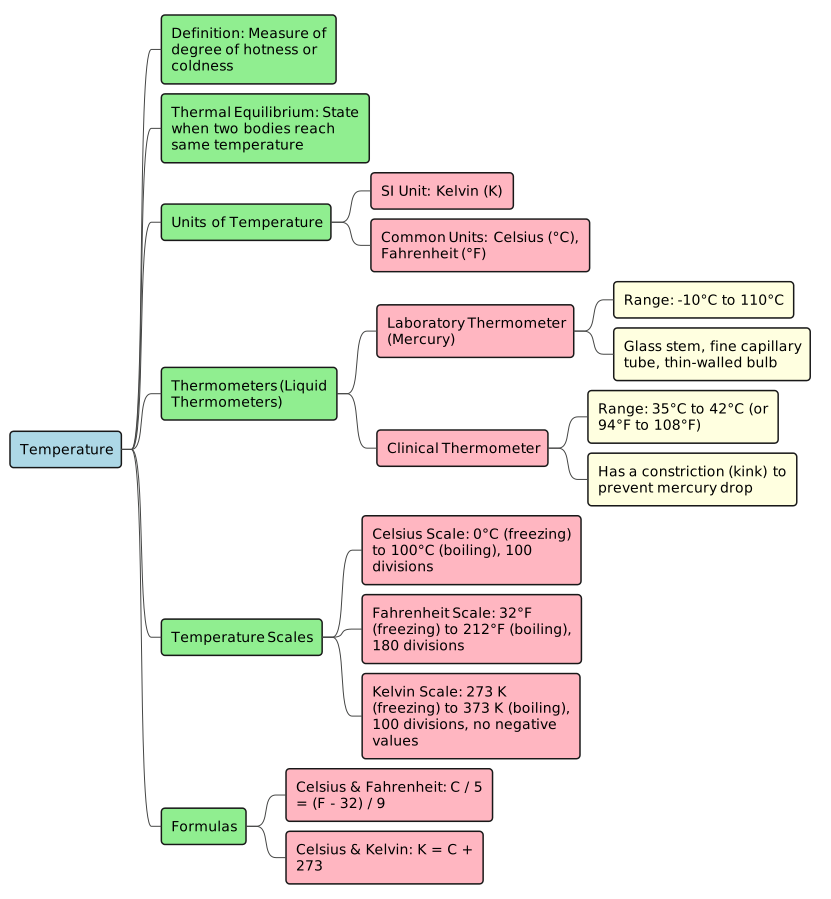
Definition of Temperature:Temperature is the measure of the degree of hotness or coldness of a body.Our sense of touch is inaccurate and cannot measure the exact heat energy. Temperature serves as a reliable, measurable quantity that reflects the amount of heat energy in a body.Thermal Equilibrium:When two bodies at different temperatures are brought into contact, heat transfers from the hotter body to the colder body.This transfer continues until both bodies reach the exact same temperature, achieving a state called thermal equilibrium.Units of Temperature:Kelvin (K): The standard SI unit used in scientific measurements.Degree Celsius (°C) and Degree Fahrenheit (°F): Commonly used everyday units.
Thermometer: An instrument used for measuring temperature.Liquid Thermometer: Thermometers that use a liquid (typically mercury or alcohol) as a thermometric medium.Structure: Consists of a thick glass stem with a very fine bore capillary tube inside. One end of the tube features a thin-walled glass bulb filled with mercury (visible as a shiny thread). The air is evacuated before the other end is sealed.Range: Typically graduated from -10°C to 110°C.Working: When placed in a hot substance, the mercury expands and rises up the capillary tube. The final constant level marks the temperature.Structure: Designed specifically to measure human body temperature. It features a slight bend or kink called a constriction in the capillary tube just above the bulb.Purpose of Constriction: Prevents the mercury level from dropping immediately when the thermometer is removed from the patient’s mouth, allowing doctors to read the temperature accurately.Range: Graduated from 35°C to 42°C (or 94°F to 108°F), matching the survival limits of human body temperature.Handling: Must be washed and then jerked sharply to force the mercury back below the constriction before the next use.
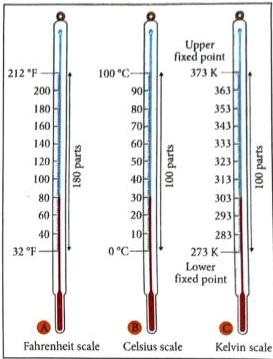
Celsius Scale:Invented by Anders Celsius.Lower standard point (freezing point of water): 0°C.Higher standard point (boiling point of water): 100°C.Interval is divided into 100 equal divisions.Fahrenheit Scale:Invented by Daniel Gabriel Fahrenheit.Lower standard point (freezing point of water): 32°F.Higher standard point (boiling point of water): 212°F.Interval is divided into 180 equal divisions.Kelvin Scale:Introduced by Lord Kelvin.Has no negative values. The lowest limit is absolute zero (0 K).Lower standard point (freezing point of water): 273 K.Higher standard point (boiling point of water): 373 K.Interval is divided into 100 equal divisions.
Between Celsius © and Fahrenheit (F):C / 5 = (F - 32) / 9Or: F = (C * 9/5) + 32Or: C = 5/9 * (F - 32)Between Kelvin (K) and Celsius ©:K = C + 273Example: Normal human body temperature is 37°C, which converts to 98.6°F and 310 K.
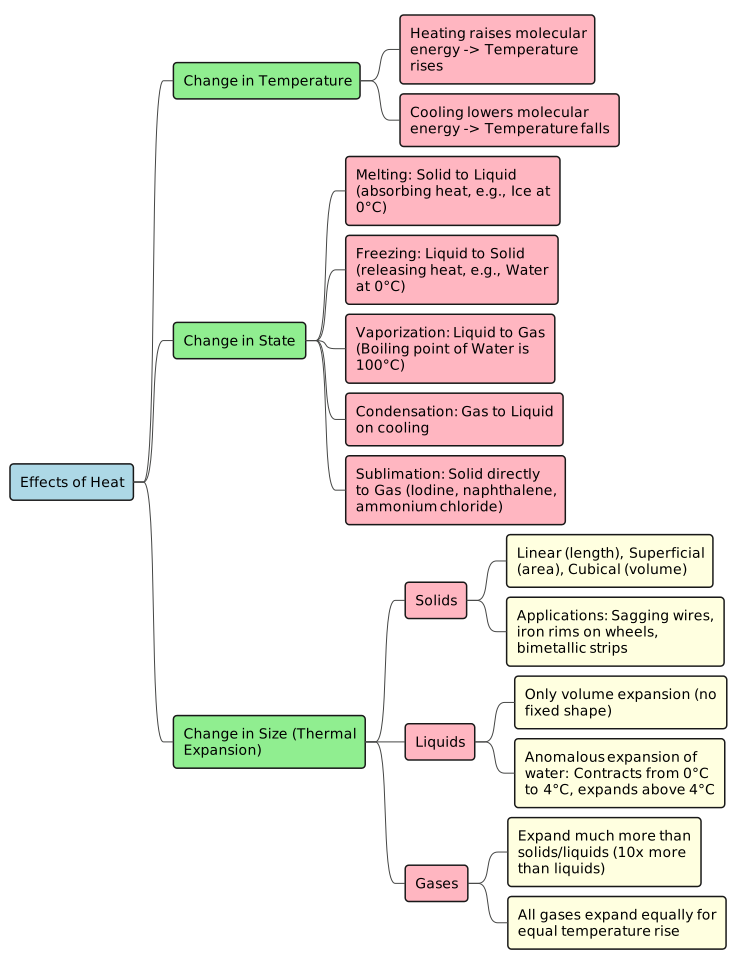
Heating a substance adds energy to its molecules, causing them to move faster, which results in a rise in temperature.Cooling a substance causes its molecules to lose energy, resulting in a fall in temperature.
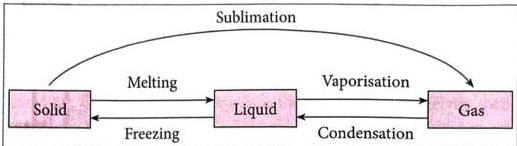
Matter can change states (solid, liquid, gas) by absorbing or releasing heat.Melting: The process where a solid changes to a liquid by absorbing heat at a fixed temperature (melting point). The melting point of pure ice is 0°C.Freezing: The process where a liquid changes to a solid by releasing heat at a fixed temperature (freezing point). For water, this is 0°C.Vaporization: The process where a liquid changes into vapor at a fixed temperature. This occurs via boiling (at a fixed boiling point) or evaporation. The boiling point of water is 100°C.Condensation: The process where a gas/vapor cools down and changes into a liquid state. The condensation point of steam is 100°C.Sublimation: The process where a solid converts directly into a gas on heating, without passing through the liquid state. Examples: Iodine, naphthalene, and ammonium chloride.Myth: The temperature has to be below zero degrees Celsius for snow to fall.Fact: For snow precipitation to occur, the air temperature only needs to be below 2°C. If the air temperature is higher than 2°C, the falling snowflakes melt and turn into sleet or rain.
Thermal Expansion: Heating a substance increases molecular movement, increasing intermolecular space and overall volume.Contraction: Cooling a substance decreases molecular movement, decreasing its volume.Rate of Expansion: Gases expand far more than liquids, and liquids expand more than solids.Linear Expansion: Increase in the length of a solid.Superficial Expansion: Increase in the surface area of a solid.Cubical Expansion: Increase in the volume of a solid.Property: Different solids expand to different extents for the same rise in temperature.Applications in Day-to-Day Life:Sagging Electric Wires: Overhead telephone and electric wires are hung loosely between poles to prevent them from snapping due to contraction during cold winter months.Iron Rims on Bullock Cart Wheels: Metal rims are made slightly smaller than the wooden wheels. The rims are heated to expand before being fitted onto the wheels. Upon cooling, the iron contracts and tightly grips the wooden wheel.Bimetallic Strips: Made of two different metals fused together. Because the metals expand and contract at different rates, the strip bends when temperature changes (bending towards the metal with lower expansion on heating, and towards the metal with higher expansion on cooling). These are widely used in circuit breakers and thermostats.Liquids do not have a fixed shape, so they only exhibit volume (cubical) expansion.Liquids expand much more than solids.Anomalous Expansion of Water: Unlike other liquids, water contracts when heated from 0°C to 4°C. Above 4°C, it expands normally.Property: Equal volumes of different liquids expand to different extents (e.g., benzene expands more than water when heated).Gases only exhibit volume expansion and expand the most out of all states of matter (ten times more than liquids for the same heat).Unlike solids and liquids, all gases expand equally for an equal rise in temperature.
Definition: The transfer of heat in solids from a region of higher temperature to a region of lower temperature without any actual movement of the molecules from their positions.Molecular Mechanism: Molecules in solids are tightly packed. When one end is heated, molecules at that end absorb energy and vibrate rapidly. They collide with neighboring molecules, transferring some energy. This kinetic vibration passes sequentially down the length of the solid.Good Conductors: Substances that allow heat to pass through them easily.Examples: All metals. Silver is the best conductor, followed by copper, aluminium, and iron.Exception: Mercury is a liquid but is an excellent conductor of heat.Bad Conductors (Insulators): Substances that do not allow heat to pass through them easily.Examples: Wood, glass, plastic, rubber, paper, asbestos, sawdust, and most liquids and gases (like water and air).Cooking Utensils: Made of metals like aluminium or iron to conduct heat quickly to cook food.Utensil Handles: Fitted with insulators like plastic, wood, or ebonite to prevent heat from reaching our hands.Inuit Igloos: Built using double-walled ice. The air trapped between the two walls acts as an insulator, blocking cold from entering and body heat from escaping.Woollen Clothing: Wool fibers trap air. Both wool and air are bad conductors, preventing body heat from escaping into the cold winter air.Ice Storage: Covered with sawdust or woollen cloth because the air trapped in their pores insulates the ice from outside environmental heat, slowing down melting.Asbestos and Clay Roofs: Used in houses as insulators to keep interiors protected from outside heat.Car Radiators: Use copper tubing because copper efficiently absorbs heat from the hot water coming from the engine.
Definition: The mode of heat transfer in liquids and gases (fluids) by the actual physical movement of their molecules from hotter regions to colder regions.Direction: Convection always transfers heat vertically upwards.Mechanism: When a fluid is heated, it expands, becomes less dense (lighter), and rises. The cooler, denser fluid from the top sinks to take its place. This circular movement sets up a convection current.Sea Breeze (Daytime):Land heats up faster than the sea.Warm air over land rises up.Cooler air from the sea rushes in to take its place, creating a cool sea breeze.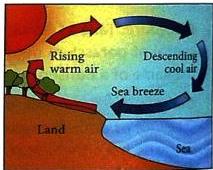 Land Breeze (Nighttime):Land cools down faster than the sea.Air over the sea remains warmer and rises.

Share
Explore
 Self Study
Prepared by: learnloophq@gmail.com
Chapter: 05. Heat
CHAPTER 5: HEAT - STUDY NOTES
1. Heat as a Form of Energy
Units of Heat
2. Temperature and its Measurement
Measuring Instruments (Thermometers)
A. Laboratory Thermometer (Mercury Thermometer)

B. Clinical Thermometer (Doctor’s Thermometer)

Scales of Temperature
Comparison of Temperature Scales
Scale
Symbol
Lower Standard Point (Freezing Point)
Higher Standard Point (Boiling Point)
Number of Divisions
Celsius
°C
0
100
100
Fahrenheit
°F
32
212
180
Kelvin
K
273
373
100
Temperature Conversion Formulas
3. Effects of Heat
Heat energy causes significant physical and chemical changes in both living and non-living matter:
A. Change in Temperature
B. Change in State
Myth vs. Fact Box
C. Change in Size (Thermal Expansion & Contraction)
1. Thermal Expansion in Solids
2. Thermal Expansion in Liquids
3. Thermal Expansion in Gases
4. Methods of Heat Transfer
Heat transfers from hotter regions to cooler regions via three distinct processes: Conduction, Convection, and Radiation.
Conduction
Good vs. Bad Conductors of Heat
Daily Life Applications of Conductors and Insulators
Convection
Daily Life Applications of Convection Currents
Want to print your doc?
This is not the way.
This is not the way.

Try clicking the ··· in the right corner or using a keyboard shortcut (
CtrlP
) instead.