Skip to content
Which level of organisation is represented by simple multicellular organisms like algae and sponges?
(a) Organ level
(b) Tissue level
© Cellular level
(d) Organ system levelWho is known as the Father of Modern Histology?
(a) Marie Francois Xavier Bichat
(b) Robert Hooke
© Anton van Leeuwenhoek
(d) Charles DarwinWhich of the following tissues are formed of actively dividing young cells that are responsible for plant growth?
(a) Permanent tissues
(b) Protective tissues
© Conducting tissues
(d) Meristematic tissuesThe only living cells present in the xylem tissue are:
(a) Xylem vessels
(b) Xylem tracheids
© Xylem parenchyma
(d) Xylem fibresWhich connective tissue joins skeletal muscles to the bones?
(a) Ligaments
(b) Tendons
© Cartilage
(d) Areolar tissueWhich type of muscular tissue is found in the wall of the heart and has branched, cylindrical fibres?
(a) Striated muscle
(b) Nonstriated muscle
© Voluntary muscle
(d) Cardiac muscle
In leaves, the epidermis secretes a waxy and waterproof layer called the _ _ _ _ _ _ _ _ _ _ _ _ _ _.Meristematic cells have thin walls, large nuclei, and their vacuoles are either absent or _ _ _ _ _ _ _ _ _ _ _ _ _ _.Yellow elastic fibrous tissue forms _ _ _ _ _ _ _ _ _ _ _ _ _ _, which connect two bones together at the joints.Red blood cells and white blood cells are formed in the red bone marrow of _ _ _ _ _ _ _ _ _ _ _ _ _ _.Axons of several neurons are bundled together to form a _ _ _ _ _ _ _ _ _ _ _ _ _ _.
Simple multicellular organisms like algae and sponges have division of labour among their cells.All phloem cells are living except phloem fibres.Some parenchyma cells contain chlorophyll and are called chlorenchyma.Bones are highly elastic skeletal tissues.Nonstriated muscles are voluntary in nature.
OrganisationSieve platesAreolar tissueLymph
Meristematic Tissues and Permanent Tissues (Ability of cells to divide)Tendon and Ligament (Elasticity and type of tissue)Simple Permanent Tissue and Complex Permanent Tissue (Number of cell types forming the tissue)
Why are white blood cells (WBCs) called the ‘soldiers of the body’?Mention the two major functions of meristematic tissues in plants.Where is collenchyma tissue found in plants, and what is its main function?State the main components of the shoot system and the root system in plants.What are the three parts that make up a neuron?
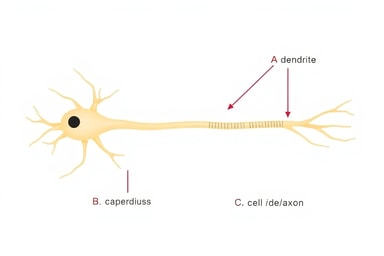
Identify the specific cell represented in the diagram.Label the parts marked A, B, and C.State the main function of part C.
Classify plant tissues by creating a clear hierarchy. Describe the functions of simple supporting tissues (parenchyma, collenchyma, and sclerenchyma) in detail.Discuss epithelial tissues in animals. Describe their general locations, key characteristics, and explain three different types of epithelial tissues based on cell shapes.

Share
Explore
 Question Paper
Prepared by: learnloophq@gmail.com
Chapter: 01. Tissues
CHAPTER 1: TISSUES
PRACTICE EXAM PAPER
Class: VII
Subject: Biology
Time Allowed: 2 Hours
SECTION A: MULTIPLE CHOICE QUESTIONS
Choose the correct option for each of the following questions.
SECTION B: FILL IN THE BLANKS
Fill in the blanks with suitable words. Use ‘_ _ _ _ _ _ _ _ _ _ _ _ _ _’ for the blank.
SECTION C: TRUE OR FALSE
State whether the following statements are True or False. If false, rewrite the correct statement.
SECTION D: EXPLANATION OF TERMS
Define or explain the following terms in one or two sentences.
SECTION E: DIFFERENTIATE CONCEPTS
Differentiate between the following pairs based on the criteria given in the brackets.
SECTION F: SHORT ANSWER QUESTIONS
Answer the following questions briefly.
SECTION G: DIAGRAM-BASED QUESTION
Analyze the diagram below and answer the questions that follow.
Diagram showing the structure of a typical nerve cell or neuron with parts labeled.
SECTION H: LONG ANSWER QUESTIONS
Answer the following questions in detail.
Want to print your doc?
This is not the way.
This is not the way.

Try clicking the ··· in the right corner or using a keyboard shortcut (
CtrlP
) instead.