Skip to content
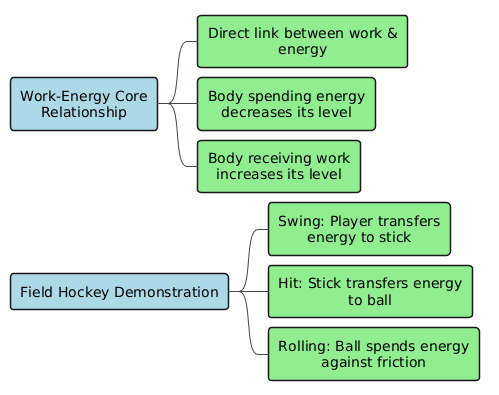
Explain the relationship between work and energy using the example of playing field hockey.There is a direct relationship between work and energy because a body must spend its energy to perform work. When a player swings a hockey stick, they do work on the stick, causing their own body’s energy level to decrease while the stick’s energy increases. When the hockey stick subsequently hits the ball, the stick’s energy decreases because of the work done by it, and the ball gains energy to roll. Once the ball’s acquired energy is fully used up by rolling against the friction of the ground, it can no longer do work and comes to a stop.
 Define kinetic energy and describe the factors that influence its magnitude.Kinetic energy is the energy possessed by an object by virtue of its motion, derived from the Greek word ‘kinesis’ which means motion. The magnitude of this energy depends primarily on two factors: the mass of the object and its speed. A greater mass results in higher kinetic energy, which is why being hit by a heavier cricket ball hurts more than a lighter tennis ball moving at the same speed. Additionally, a faster speed increases kinetic energy, meaning a fast-moving tennis ball possesses more energy and impact than a slow-moving one.
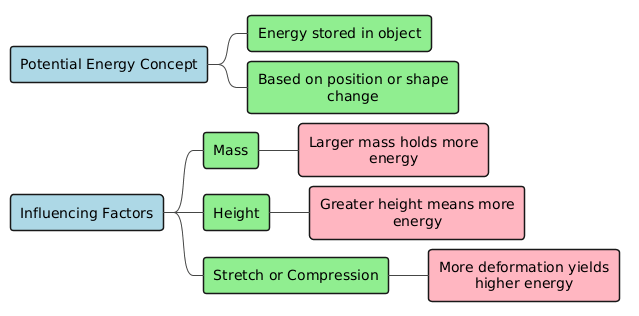
 Describe potential energy and explain the factors that determine how much potential energy is stored in an object.Potential energy is the energy stored in an object by virtue of its position above the ground or a change in its shape. One primary factor determining its magnitude is the mass of the object, as more work is required to lift a heavier object compared to a lighter one to the same height. Another crucial factor is the height of the object above the ground, meaning the higher an object is raised, the greater its potential energy becomes. Additionally, potential energy increases as an object is stretched or compressed more, such as in the case of a stretched rubber band.
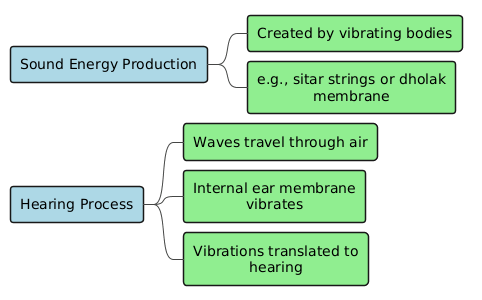
 Explain how sound energy is produced and how we are able to hear it.Sound energy is produced by vibrating bodies, such as the strings of a sitar or the membrane of a beaten dholak, which cause the sensation of hearing. When these objects vibrate, they create sound waves that travel through the air. As these waves reach our ears, they cause the membrane inside our ear to start vibrating in response. This vibration of the internal ear membrane allows us to perceive and hear the sound. Since these vibrations are a form of motion, sound energy is fully capable of doing work.
 State the law of conservation of energy and explain how it applies to a swinging simple pendulum.The law of conservation of energy states that energy can neither be created nor be destroyed, meaning the total energy in a system always remains constant and only transforms from one form to another. In a simple pendulum, the bob possesses maximum potential energy and zero kinetic energy at its highest leftmost and rightmost positions of rest. As the bob swings downward towards the center, this potential energy is progressively converted into kinetic energy, reaching maximum speed and kinetic energy at its lowest point. As it rises again, the kinetic energy is converted back into potential energy, keeping the sum of both energies constant at every point in the swing.


Share
Explore
 Long Answers
Prepared by: learnloophq@gmail.com
Chapter: 03. Energy
Want to print your doc?
This is not the way.
This is not the way.

Try clicking the ··· in the right corner or using a keyboard shortcut (
CtrlP
) instead.