Skip to content
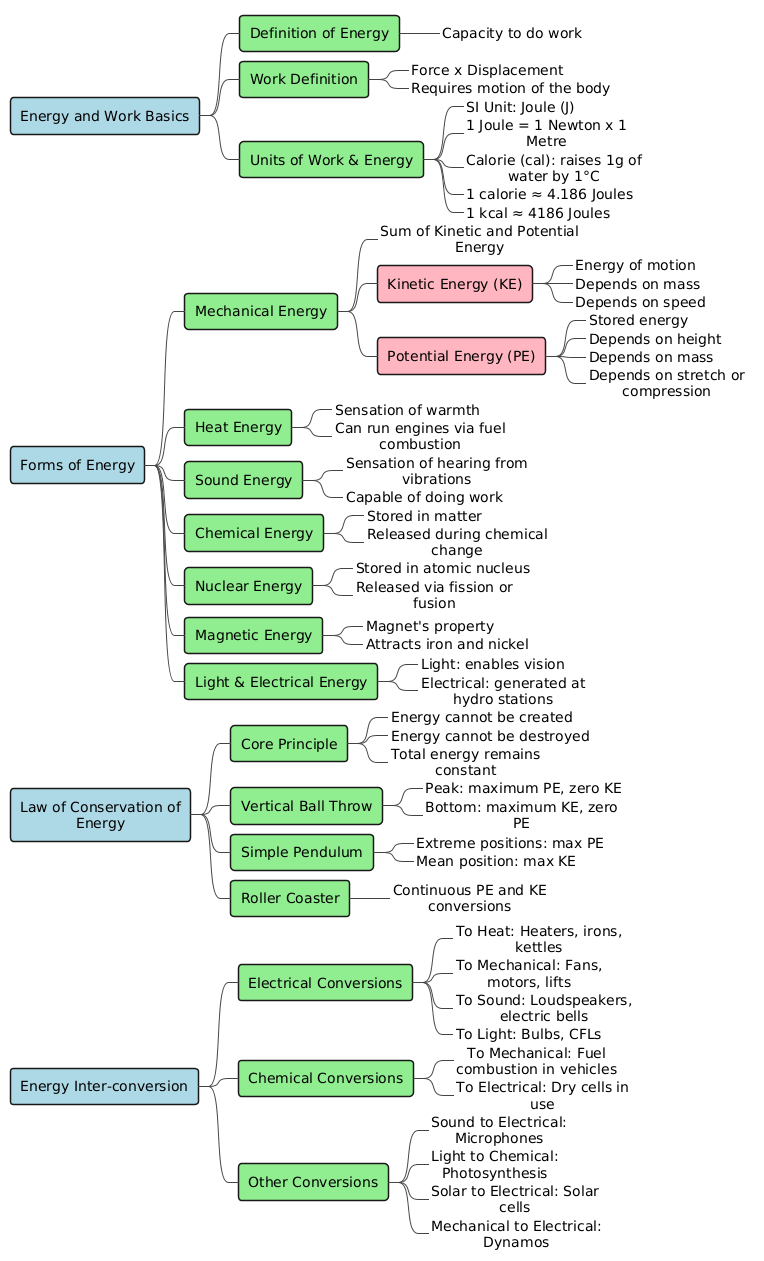
Definition: Energy is the capacity to do work.Relationship with Work:A body spends energy while doing work.When work is done by a body, its energy decreases.When work is done on a body, its energy increases.
Work is said to be done if the applied force is sufficient to produce motion (displacement) in a body.No work is done if the force cannot produce any motion.The amount of work done is the product of the force applied and the displacement of the body in the direction of the force.
SI Unit of Work: joule (J), named in honour of scientist J.P. Joule.   One joule of work is done when a force of  
   displaces a body through a distance of  
   in the direction of the force.SI Unit of Energy: Also joule (J). A body has  
   of energy if it has the capacity to do    of work.Common Unit of Energy: calorie (cal).Definition of Calorie: The amount of heat energy needed to raise the temperature of  
   of water by  
  .Relation between Joule and Calorie: 


Definition: The energy acquired by an object by virtue of its position or state of motion.Formula:    Definition: The energy possessed by an object by virtue of its motion. It equals the work done in bringing the body to a state of motion.Factors affecting Kinetic Energy:Mass of the object: Greater mass  
   greater kinetic energy (e.g., hitting with a heavy cricket ball hurts more than a lighter tennis ball at the same speed).Speed of the object: Faster speed    greater kinetic energy (e.g., a fast-moving tennis ball hurts more than a slow-moving one).Examples: A moving carrom striker, rotating blades of a mixer grinder.Definition: The energy stored in an object by virtue of its position above the ground or a change in its shape. It equals the work done in bringing the body to its current position of rest.Factors affecting Potential Energy:Mass of the object: Greater mass at the same height    greater potential energy.Height above the ground: Higher object    greater potential energy.Stretch or compression: Greater deformation (stretching/compressing)    greater potential energy.Examples: A child sitting at the top of a slide, water stored in a dam, a stone lifted to a height, a stretched rubber band.When a weight is held at a height, it has only potential energy.As it falls, potential energy is progressively converted into kinetic energy.Just before hitting the ground, all potential energy is converted to kinetic energy. On impact, the mechanical energy is fully used up.
Heat Energy: Gives the sensation of warmth. It is capable of doing work, such as burning fuels (petrol, diesel, CNG, LPG) to run automobiles, trains, planes, and ships.Light Energy: Enables us to see objects. While it does not ordinarily move large objects, a very strong beam can move tiny particles like electrons.Magnetic Energy: Energy possessed by a magnet. It attracts and moves magnetic metals like iron and nickel. Used in refrigerator doors, pencil boxes, and electric motors.Electrical Energy: Highly useful form of energy generated at hydroelectric power stations, generators, and chemical batteries. It is easily converted to magnetic, heat, light, or sound energy to power everyday appliances.Sound Energy: Produced by vibrating bodies (e.g., strings of a sitar, membrane of a dholak, electric bells) causing the sensation of hearing. Capable of doing work (e.g., sound-controlled remote systems).Chemical Energy: Energy stored in matter, released only during a chemical change. Examples include matchsticks, fuels (wood, coal, LPG), food (converted to muscular energy), and firecrackers.Nuclear Energy: Stored in the nucleus of atoms. Released via nuclear fission (splitting) or nuclear fusion (combining) as radiation waves. Used to produce steam to turn turbines for electricity.
Statement: Energy can neither be created nor be destroyed. The total amount of energy in a system always remains constant. It can only be transformed from one form to another.
A Ball Thrown Vertically Upwards:At maximum height: The ball stops momentarily; it has maximum potential energy and zero kinetic energy.During descent: It loses height (PE decreases) and gains speed (KE increases).Just before touching ground: It has maximum kinetic energy and zero potential energy.Note: The sum of PE and KE remains constant at every point in its path (assuming zero air friction).A Roller Coaster:As the coaster rides, energy continuously shifts between potential energy (at the peaks) and kinetic energy (at the valleys). The total energy remains constant throughout.A Simple Pendulum:Extreme positions (highest points): The bob stops momentarily; Potential Energy is at its maximum and Kinetic Energy is zero.Mean position (lowest point): The bob moves fastest; Kinetic Energy is at its maximum and Potential Energy is zero.Intermediate positions: The bob possesses both PE and KE, but the total mechanical energy remains conserved.

Share
Explore
 Recap Hub
Prepared by: learnloophq@gmail.com
Chapter: 03. Energy
CRASH COURSE REVISION MATERIAL: ENERGY
1. UNDERSTANDING WORK AND ENERGY
What is Energy?
What is Work?
   
 
Units of Work and Energy
2. DIFFERENT FORMS OF ENERGY
Mechanical Energy
A. Kinetic Energy (KE)
B. Potential Energy (PE)
C. Conversion of PE into KE
Non-Mechanical Forms of Energy
3. INTER-CONVERSION (TRANSFORMATION) OF ENERGY
Energy can be transformed from one form to another. Below is a comprehensive list of energy inter-conversions:
Original Energy Form
Converted Energy Form
Everyday Example / Device
Heat
Electrical
Thermal power stations
Heat
Chemical
Preparation of certain chemical compounds
Heat
Mechanical
Steam engines, steam turbines
Mechanical
Electrical
Generators, dynamos
Mechanical
Heat
Electric drills, friction between two rubbing hands
Electrical
Heat
Heaters, irons, geysers, electric kettles
Electrical
Chemical
Recharging chemical batteries
Electrical
Mechanical
Fans, motors, washing machines, grinders, lifts, electric trains
Electrical
Sound
Loudspeakers, electric bells, music systems, telephone speakers
Electrical
Magnetic
Electromagnets
Electrical
Light
Bulbs, tube lights, CFLs
Chemical
Mechanical
Vehicles (combustion of fuels)
Chemical
Heat
Burning of fuels, bursting of crackers
Chemical
Electrical
Car batteries, dry cells (while in use)
Sound
Electrical
Microphones
Light
Chemical
Photosynthesis in plants
Solar
Heat
Solar cookers, solar water heaters
Solar
Electrical
Solar cells
4. THE LAW OF CONSERVATION OF ENERGY
Standard Examples:
Want to print your doc?
This is not the way.
This is not the way.

Try clicking the ··· in the right corner or using a keyboard shortcut (
CtrlP
) instead.