Skip to content
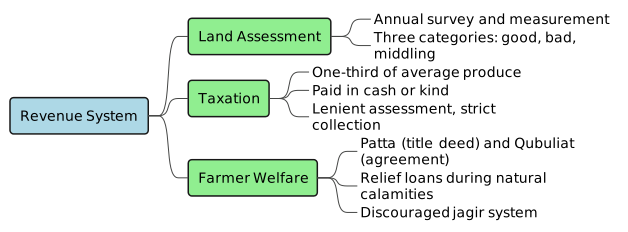
Explain the land assessment and revenue collection system established by Sher Shah Suri.Sher Shah Suri introduced a highly organized revenue system where land was carefully surveyed and measured every year. The land was classified into three categories—good, bad, and middling—based on its inherent fertility, and the average produce was calculated accordingly. Peasants were required to pay one-third of this average produce as tax, which could be paid in either cash or kind. To secure the mutual rights and duties of the government and the peasants, Sher Shah introduced the system of patta (title deeds) and qubuliat (agreements). Additionally, the government discouraged the jagir system and actively granted loans or reduced taxes if crops were damaged by wars or natural calamities.
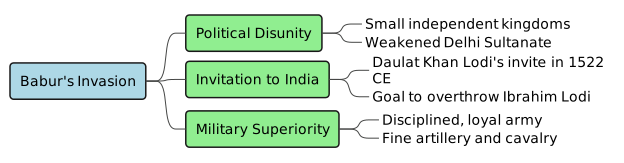
 What were the political conditions and factors in India that led to Babur’s successful invasion and conquest?At the beginning of the 16th century CE, India was highly fragmented into numerous small independent kingdoms, and the Delhi Sultanate’s power had dwindled to areas surrounding Delhi. This political disunity and discord created a perfect environment for an ambitious ruler like Babur to invade. Seizing a golden opportunity, Daulat Khan Lodi invited Babur in 1522 CE to help him overthrow the unpopular Sultan Ibrahim Lodi. Babur quickly became the master of the Punjab before marching towards Delhi to face Ibrahim Lodi. In the First Battle of Panipat in 1526 CE, Babur’s highly disciplined army, superior cavalry, and fine artillery decisively routed the larger Sultanate forces.
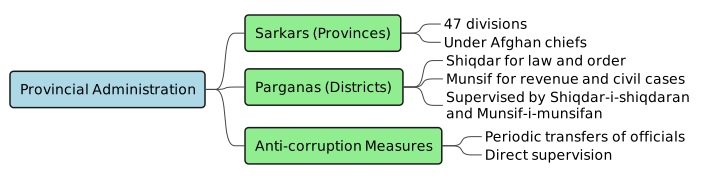
 Detail the administrative reforms introduced by Sher Shah Suri at the provincial and district levels.Sher Shah Suri divided his empire into 47 provinces, known as sarkars, which were further subdivided into districts called parganas. Each sarkar was placed under an Afghan chief, while the administration of parganas was managed by multiple officials. The shiqdar was responsible for maintaining law and order, whereas the munsif looked after civil cases and revenue collection. These local officials were supervised by higher authorities, namely the shiqdar-i-shiqdaran and the munsif-i-munsifan. To prevent these administrators from becoming corrupt or overly powerful, Sher Shah introduced a system of periodic transfers.
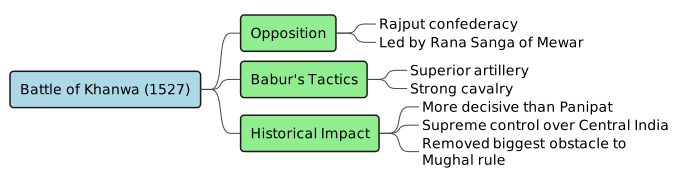
 Explain the significance of the Battle of Khanwa and how it differed from the First Battle of Panipat.While the First Battle of Panipat in 1526 CE marked the defeat of the Sultan of Delhi, the Battle of Khanwa in 1527 CE was a far more decisive victory for Babur. At Khanwa, Babur’s army clashed with the powerful Rajput confederacy led by Rana Sanga of Mewar. Despite the desperate valour and courage shown by the Rajputs, Babur won the battle using his superior artillery and cavalry. This victory gave Babur supreme control over central India and effectively removed the Rajputs as the biggest obstacle to Mughal rule. Consequently, no other Rajput chief dared to challenge Babur’s authority after his subsequent capture of Chanderi.
 Discuss the difficulties and internal challenges Humayun faced upon inheriting the Mughal empire.Humayun inherited a vast but fragile empire that stretched from Kabul to Bihar, which completely lacked cohesion and stability. He lacked the essential personal qualities and military decisiveness required to consolidate and manage such a large territory. Furthermore, he was surrounded by hostile elements, including ambitious Afghan chiefs like Sher Khan Suri and the powerful Bahadur Shah of Gujarat. In accordance with his father’s dying wishes, Humayun generously divided the empire among his three younger brothers. However, his brothers proved to be openly hostile, constantly plotting against him and refusing to help him during his times of crisis.


Share
Explore
 Answer key
Prepared by: learnloophq@gmail.com
Chapter: 08. Babur Humayun And Sher Shah
Want to print your doc?
This is not the way.
This is not the way.

Try clicking the ··· in the right corner or using a keyboard shortcut (
CtrlP
) instead.