Skip to content

Share
Explore
 Question Paper
Prepared by: learnloophq@gmail.com
Chapter: 07. Rise Of The Vijayanagar And Bahmani Kingdoms
Practice Exam Paper: The Vijayanagar and Bahmani Kingdoms
Grade Level: Middle School (History)
Time Allowed: 2 Hours
Max Marks: 50
SECTION A: Multiple Choice Questions (MCQs) [1 mark each]
Q1. Who was the greatest ruler of the Vijayanagar kingdom, whose reign marked the height of its military glory?
(a) Harihara I
(b) Bukka Raya I
© Krishnadeva Raya
(d) Rama Raya
Q2. Which fertile area, lying between the Krishna and Tungabhadra rivers, was a constant bone of contention between the Vijayanagar and Bahmani kingdoms?
(a) Gulbarga
(b) Malabar Coast
© Bidar
(d) Raichur Doab
Q3. The Bahmani kingdom was established in 1347 CE by an official who took the title of:
(a) Mahmud Gawan
(b) Alauddin Bahman Shah
© Adil Shah
(d) Muhammad Shah III
Q4. The famous Portuguese traveller who visited the Vijayanagar empire during the reign of Krishnadeva Raya was:
(a) Abdur Razzaq
(b) Amir Timur
© Domingo Paes
(d) Marco Polo
SECTION B: Fill in the Blanks [1 mark each]
Instructions: Write the correct word in the blank provided. Use _ _ _ _ _ _ _ _ _ _ _ _ _ _ for each blank.
Q5. The Vijayanagar kingdom was established in 1336 CE by two brothers on the banks of the river _ _ _ _ _ _ _ _ _ _ _ _ _ _.
Q6. The final blow to the Tughlaq dynasty was dealt in 1398–99 CE by the Mongol ruler _ _ _ _ _ _ _ _ _ _ _ _ _ _.
Q7. In the Bahmani kingdom, foreign nobles were called _ _ _ _ _ _ _ _ _ _ _ _ _ _ while the local nobles were known as Deccanis.
Q8. The _ _ _ _ _ _ _ _ _ _ _ _ _ _ at Bijapur is a simple but impressive structure featuring the second largest whispering dome in the world.
SECTION C: True or False [1 mark each]
Instructions: State whether the following statements are True or False. If False, rewrite the statement correctly.
Q9. The Vijayanagar kingdom was divided into nine provinces, each placed under the charge of a governor.
Q10. The Bahmani rulers patronized Islam and used Persian and Arabic as court languages.
Q11. The rigid caste system was absent in the Vijayanagar society, and Brahmanas held very little power.
SECTION D: Explanations of Terms [2 marks each]
Instructions: Briefly explain the meaning of the following terms in relation to the chapter:
Q12. Mandalam
Q13. Pardesis
Q14. Sati
SECTION E: Identifying and Differentiating Concepts [3 marks each]
Q15. Differentiate between the Deccani and Pardesi nobles of the Bahmani kingdom.
SECTION F: Short Answer Questions [3 marks each]
Q16. What was the political impact of the Battle of Talikota in 1565 CE on the Vijayanagar kingdom?
Q17. Mention any three military or administrative achievements of the Bahmani wazir Mahmud Gawan.
Q18. State two examples that show the Vijayanagar kings were religiously tolerant and liberal.
SECTION G: Diagram-Based Questions [5 marks]
Below is a hierarchical diagram showing the administrative structure of the Vijayanagar Empire.
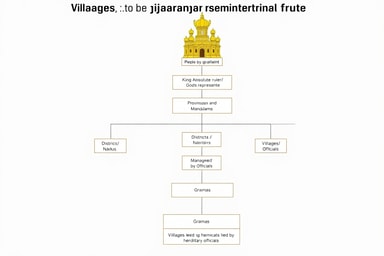
Q19. Based on your reading of the diagram and the chapter content, answer the following questions:
(a) Who was the absolute head of the administration, and how was he regarded by his subjects? (1 Mark)
(b) Identify the local administrative unit that occupied the bottom rung of the administrative ladder. (1 Mark)
© Explain the nature of the posts held by the officers of the village administration. (1.5 Marks)
(d) What were the districts of the empire called, and what lay immediately below them? (1.5 Marks)
SECTION H: Long Answer Questions [5 marks each]
Q20. The disintegration of the Delhi Sultanate during the Tughlaq dynasty was marked by structural failures and external shocks. Explain any four main causes for this disintegration that paved the way for the rise of independent kingdoms in the south.
Q21. Describe the economic conditions of the Vijayanagar kingdom. What were its main sources of revenue, and how did trade enrich its treasury?
Want to print your doc?
This is not the way.
This is not the way.

Try clicking the ··· in the right corner or using a keyboard shortcut (
CtrlP
) instead.