Skip to content
Describe the circumstances and historical background that led to the birth and rise of Christianity in Palestine.In the middle of the 1st century BCE, the Romans conquered Palestine, the homeland of the Jews, and appointed a puppet ruler named Herod. Under Herod’s rule, the Jewish people suffered grave injustice, oppression, and a severe loss of freedom. Based on the predictions of the Prophets in the Old Testament, the Jews looked forward with faith and hope to the coming of a Messiah who would liberate them from foreign bondage. It was during this period of oppression, around 6–4 BCE, that Jesus was born to Mary and Joseph in the tiny village of Bethlehem in Judea. His teachings and the belief in his resurrection eventually led to the emergence and rapid spread of the Christian community.
 Explain the fundamental principles and teachings of Jesus Christ as detailed in the text.The teachings of Jesus were simple yet revolutionary, establishing a clear code of conduct based on unconditional love for God and true love for one’s neighbor. He preached that there is only one God who is compassionate, loving, and forgiving, and that humans should mold themselves in His image. Jesus emphasized helping the needy, loving everyone including the poor, sinners, and enemies, and doing good even to those who cause harm. He completely rejected the ancient retaliatory principle of ‘an eye for an eye and a tooth for a tooth’ in favor of forgiveness. Ultimately, his mission was not to change Jewish laws but to propagate them according to his spiritual interpretation of the scriptures.
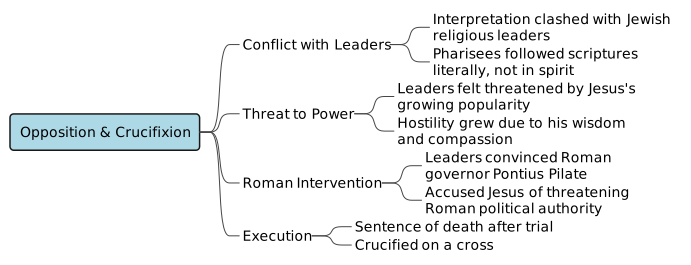
 Detail the events and reasons that led to the opposition against Jesus and his subsequent crucifixion.Jesus’s growing popularity, intelligence, compassion, and simplicity attracted massive crowds wherever he went. However, his spiritual interpretation of Jewish laws clashed directly with the literal views of the Jewish religious leaders, such as the Pharisees. Feeling deeply threatened by his influence, these religious leaders grew hostile and conspired against him. They convinced Pontius Pilate, the Roman governor, that Jesus posed a direct threat to the political authority of the Romans. Consequently, Jesus was put on trial, sentenced to death, and died a slow and painful death by crucifixion.
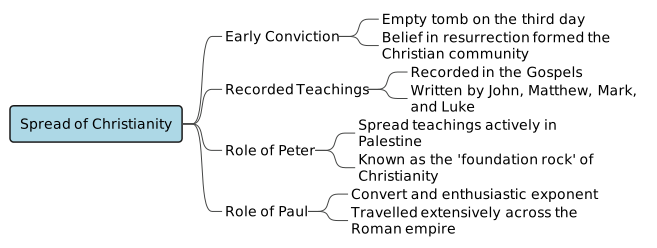
 Describe how Christianity spread after the death of Jesus, highlighting the roles of key disciples.Following the crucifixion, the conviction among his followers that Jesus had resurrected led to the emergence of the Christian community. His life and teachings were recorded in the Gospels by four of his disciples: John, Matthew, Mark, and Luke. Within Palestine, the teachings of Jesus were spread most actively by Peter, who is recognized as the foundation rock of Christianity. Later, a convert named Paul became an enthusiastic exponent, travelling extensively throughout the Roman empire to spread the faith. These combined efforts prepared the grounds for Christianity to eventually transform into a major world religion.
 Analyze the role of Emperor Constantine in changing the status of Christianity in Europe.For almost 300 years after Jesus’s death, Christians were an oppressed and persecuted religious minority within the Roman empire. In 313 CE, Emperor Constantine won a major battle against his rival Maxentius and attributed this victory to the divine inspiration of Jesus. This prompted Constantine to declare Christianity a legal religion, officially ending the long era of persecution. He eventually defeated all his rivals, declared himself a Christian, and shifted the capital to Constantinople, which became a Christian capital. Toward the end of the 4th century CE, Christianity was made the official religion of the Roman empire, with St. Peter’s Basilica becoming its religious headquarters.


Share
Explore
 Long Answers
Prepared by: learnloophq@gmail.com
Chapter: 01. Rise Of Christianity
Want to print your doc?
This is not the way.
This is not the way.

Try clicking the ··· in the right corner or using a keyboard shortcut (
CtrlP
) instead.