Skip to content
Who introduced the concept of allergy in 1906 and defined it as “an altered capacity of the body to react to a foreign substance”?
(a) Dr. Charles Robert Richet
(b) Clemens Von Pirquet
© Gregor Mendel
(d) Louis PasteurWhich protein present in milk is responsible for triggering immediate allergic reactions like wheezing and vomiting?
(a) Gluten
(b) Casein
© Albumin
(d) PeptoneWhich of the following is an example of a perennial allergy?
(a) Spring allergy to tree pollen
(b) Winter allergy to mold spores
© Indoor allergy to pet dander
(d) Autumn allergy to ragweedDuring the first exposure to an allergen (sensitisation), which antibodies are produced by B-cells in allergic individuals?
(a) IgA antibodies
(b) IgG antibodies
© IgM antibodies
(d) IgE antibodiesA sudden, severe, and life-threatening allergic reaction characterized by a sharp drop in blood pressure and swelling of the throat is called:
(a) Contact dermatitis
(b) Allergic Asthma
© Anaphylaxis
(d) Urticaria
In Greek, the word allergy means ‘_ _ _ _ _ _ _ _ _ _ _ _ _ _’.Allergy to pollen grains is also commonly known as seasonal ‘_ _ _ _ _ _ _ _ _ _ _ _ _ _’.Plant sap and latex enter our body through the ‘_ _ _ _ _ _ _ _ _ _ _ _ _ _’ route.The skin-prick test is performed by injecting small amounts of suspended allergens ‘_ _ _ _ _ _ _ _ _ _ _ _ _ _’ into the patient’s skin.‘_ _ _ _ _ _ _ _ _ _ _ _ _ _’ are chemical substances released along with IgE antibodies that produce the actual allergic symptoms like redness and swelling.
The first exposure of an allergic person to an allergen triggers a severe allergic reaction.Fungal spores like Aspergillus and Penicillium can act as common air-borne allergens.Allergic asthma causes the widening of the bronchi, leading to easier breathing.Dr. Charles Robert Richet was awarded the Nobel Prize in 1913 for his researches on anaphylaxis.Contact dermatitis is a respiratory allergy that appears only during the spring season.
AllergensSensitisationUrticariaImmunity
Seasonal Allergy and Perennial Allergy (Basis: Period of occurrence and examples)T-cells and B-cells (Basis: Role in a normal person’s immune system when encountering an antigen)
Name the three entry routes of allergens into the human body. Give one example of an allergen for each route.How does a blood test help in predicting the type of allergy and the risk of a severe allergic reaction?State three key precautions an allergic person should take to stay safe from allergic reactions.Why is anaphylactic shock considered a medical emergency? Mention any two symptoms associated with it.
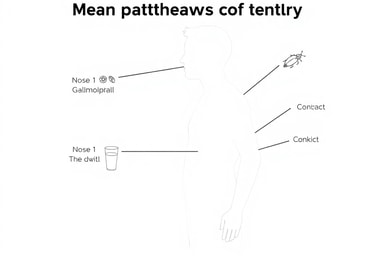
Identify the three entry routes labeled as Pointer 1, 2, and 3 in the diagram.Name one food allergen that enters the body through Route 2.If a person gets stung by a wasp, which entry route from the diagram is utilized by the allergen?
What type of allergy is Ritika suffering from during April and May? What is the likely allergen causing it?Why did her brother Rohan not show any symptoms under the same environmental conditions? Explain using the role of T-cells.What is the skin condition (red, swollen bumps) developed by Ritika after eating nuts called?Why are food allergies like nut allergy classified as perennial allergies?

Share
Explore
 Question Paper
Prepared by: learnloophq@gmail.com
Chapter: 08. Allergy
BIOLOGY PRACTICE PAPER
CLASS VII: ALLERGY
Time Allowed: 1.5 Hours
Maximum Marks: 50
SECTION A: MULTIPLE CHOICE QUESTIONS (5 Marks)
Choose the correct option for each of the following questions:
SECTION B: FILL IN THE BLANKS (5 Marks)
Fill in the blanks with appropriate words. Use ‘_ _ _ _ _ _ _ _ _ _ _ _ _ _’ for the blank space.
SECTION C: TRUE OR FALSE (5 Marks)
State whether the following statements are True or False. If False, correct the underlined word(s).
SECTION D: EXPLANATION OF TERMS (8 Marks)
Define or explain the following terms in 1–2 sentences:
SECTION E: DIFFERENTIATE BETWEEN THE CONCEPTS (6 Marks)
Distinguish between the following pairs based on the criteria provided in the brackets:
SECTION F: SHORT ANSWER QUESTIONS (8 Marks)
Answer the following questions briefly:
SECTION G: DIAGRAM-BASED QUESTION (5 Marks)
A diagram showing the human body with marked pathways where foreign substances can enter through the nose, mouth, and skin surfaces.
SECTION H: CASE-BASED / LONG ANSWER QUESTION (8 Marks)
Read the scenario below and answer the questions that follow:
Ritika is highly sensitive to the environment. During the months of April and May, she frequently suffers from severe sneezing, runny nose, and watery eyes. However, her brother Rohan does not show any such symptoms. Recently, Ritika ate a bowl of mixed-nut salad, and within minutes, she developed severe vomiting and red, swollen bumps on her skin.
Want to print your doc?
This is not the way.
This is not the way.

Try clicking the ··· in the right corner or using a keyboard shortcut (
CtrlP
) instead.