Skip to content
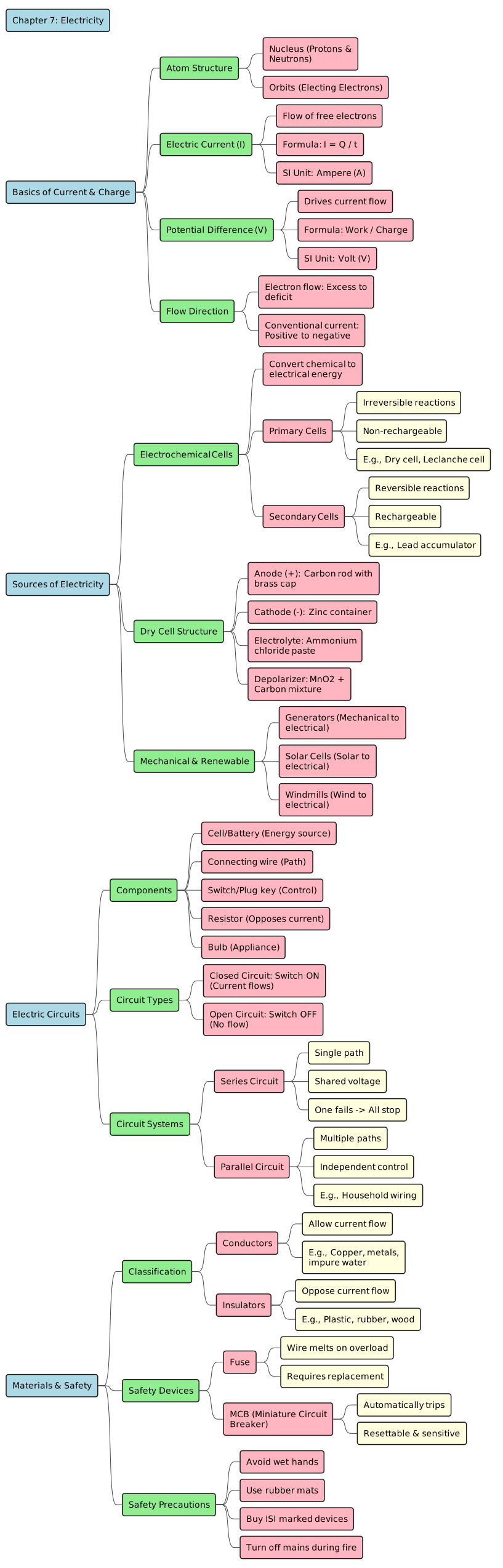
Subatomic Particles: All materials are made of atoms containing:Protons: Positively charged particles in the central nucleus.Neutrons: Neutral particles (no charge) in the nucleus.Electrons: Negatively charged particles revolving around the nucleus in orbits.Electric Current: The flow of electric charges resulting from the directed movement of free electrons. It flows from a region of excess electrons to a region deficient in electrons.Conventional Current: By convention, the direction of conventional current is taken from the positive terminal to the negative terminal of a source. This is opposite to the direction of electron flow.
Electric Current (  ): The amount of charge flowing through a conductor per unit time.
  SI Units:Electric Charge (
  ): Coulomb ©Electric Current ( ): Ampere (A)Potential Difference (
  ): Volt (V)Definition of 1 Ampere: If one Coulomb of charge flows through a conductor in one second, the current is one Ampere (
  ).
).
Definition: The amount of work done in moving a unit charge from one point to another. It sets charges in motion.Cause of Flow: A high-potential region is created by an accumulation of electrons (high repulsive force), while a low-potential region has fewer or no electrons. Current flows only when a potential difference exists.Formula: 

History: Developed in 1887 by Yai Sakizo of Japan.Construction:Cathode (Negative Electrode): Zinc container (metal case at the bottom acts as the negative terminal).Anode (Positive Electrode): Central carbon rod with a brass cap at the top (positive terminal).Electrolyte: A moist paste of ammonium chloride (  ) and plaster of Paris.Depolarizing Mixture: A mixture of manganese dioxide (
  ) and carbon (
  ) in a muslin bag surrounding the carbon rod.Insulation: Cardboard or plastic outer body to prevent leakage.
Function: Convert mechanical energy into electrical energy.Working Principle: A copper wire conductor is rotated inside a magnetic field to generate current.Power Plants:Hydroelectric: Water rotates turbines to provide mechanical energy.Thermal: Fossil fuels (coal, diesel, natural gas) produce steam to rotate turbines.Atomic/Nuclear: Nuclear energy is utilized to generate electricity.
Solar Cells: Convert solar energy directly into electrical energy. A series connection of many solar cells forms a solar panel, which is used in artificial satellites, calculators, and streetlights.Windmills: High-speed wind energy rotates blades, driving generators to produce electricity.
Closed Circuit: A complete, unbroken path where the switch is ON. Current flows, and connected appliances function (e.g., bulb glows).Open Circuit: An incomplete path with a break at some point (switch is OFF). No current flows.
Conductors: Substances that easily allow current to pass.Examples: Copper, silver, nickel, aluminium, iron, steel, impure water, and the human body.Insulators (Non-conductors): Substances that resist the flow of current.Examples: Cotton, rubber, paper, glass, ceramics, plastic, wood, pure water, and air.Resistors: Components specifically designed to provide resistance, limiting and regulating the flow of electricity in a circuit.
Fuse: A safety device containing a wire with a low melting point. It melts and breaks the circuit if the current exceeds safe limits. It must be replaced after melting.Miniature Circuit Breakers (MCBs): Automatically switches off the circuit during overloads or short circuits. They are highly sensitive, resettable (no replacement needed), help identify fault zones, and reduce power fluctuations.
Never touch switches or electrical appliances with wet hands.Avoid touching bare/live wires; ensure they are covered with insulating tape.Stand on an insulator (rubber mat or wooden board) when performing electrical work.Turn off the main switch immediately during a short circuit or electrical fire.Look for the ISI mark before purchasing any electrical appliances to ensure safety.

Share
Explore
 Recap Hub
Prepared by: learnloophq@gmail.com
Chapter: 07. Electricity
CHAPTER 7: ELECTRICITY — CRASH COURSE REVISION MATERIAL
1. ELECTRIC CURRENT AND CHARGES
Atom Structure and Charge Movement
Mathematical Expressions & SI Units
2. POTENTIAL DIFFERENCE
3. SOURCES OF ELECTRICITY
Electricity can be obtained from electrochemical cells, batteries, generators, solar cells, and wind energy.
A. Electrochemical Cells
These cells convert chemical energy into electrical energy via internal chemical reactions.
Feature
Primary Cell
Secondary Cell (Storage Cells / Accumulators)
Reversibility
Irreversible chemical reactions.
Reversible chemical reactions.
Rechargeability
Cannot be recharged; discarded after use.
Can be recharged and reused.
Applications
Torches, toys, calculators, clocks.
Mobile phones, cars, emergency lights, laptops.
Examples
Dry cell, simple Voltaic cell, Daniel cell, Leclanche cell.
Lead accumulator, Edison accumulator, nickel-iron accumulator.
B. Dry Cell (Simple Primary Cell)
C. Electric Generators (Dynamos)
D. Solar and Wind Energy
4. SIMPLE ELECTRIC CIRCUITS
An electric circuit is a closed path along which electric current flows.
Circuit Components & Symbols
Name of Component
Function
Standard Symbol
Cell
Single source of electric current
—[+
Battery
Series combination of cells
Series of cell symbols connected together
Connecting Wire
Provides path for current
—————————————
Switch / Key (Open)
Breaks circuit (Current cannot flow)
—( )— or open lever symbol
Switch / Key (Closed)
Completes circuit (Current flows)
—(•)— or closed lever symbol
Electric Bulb
Appliance producing light
Loop inside circle symbol
Resistor
Component that opposes/limits current
Zig-zag line symbol
Closed vs. Open Circuits
5. SERIES VS. PARALLEL CIRCUITS
Feature
Series Circuit
Parallel Circuit
Pathways
Single path for current.
Multiple branch paths.
Voltage Distribution
Shared across components.
Each appliance receives the original voltage.
Independence
All appliances work simultaneously. If one fails, the circuit breaks and all stop working.
All appliances work independently. If one is damaged, others continue to function.
Applications
Decorative series lights.
Household wiring systems (allows independent switches).
6. CONDUCTORS, INSULATORS, AND RESISTORS
7. SAFETY DEVICES & PRECAUTIONS
Safety Devices
Safe Practices
Want to print your doc?
This is not the way.
This is not the way.

Try clicking the ··· in the right corner or using a keyboard shortcut (
CtrlP
) instead.