Skip to content
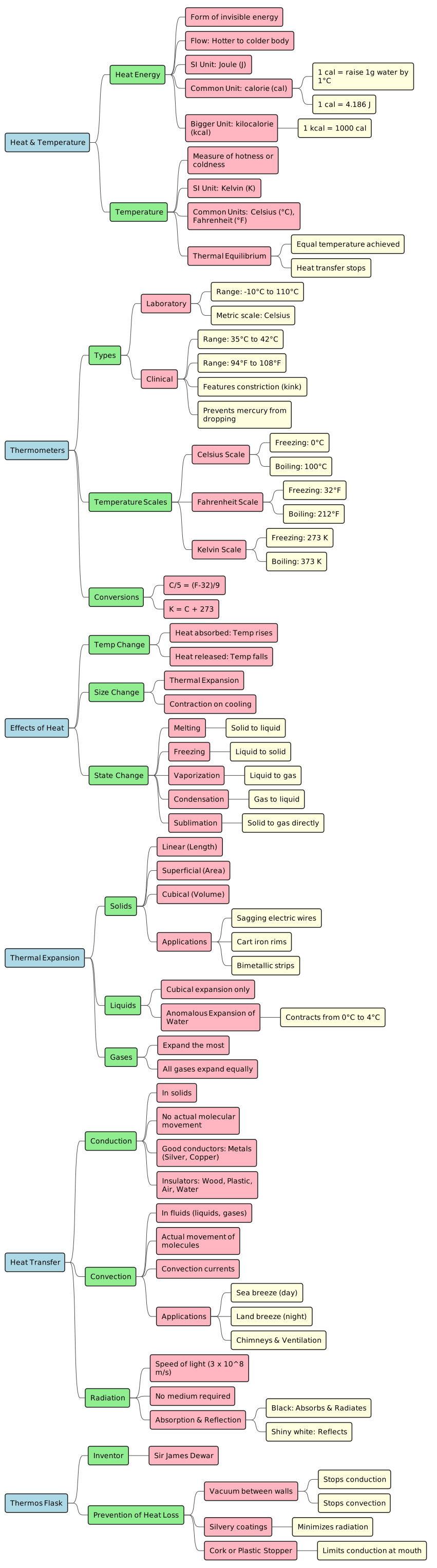
Definition of Heat: Heat is an invisible form of energy that flows from a hotter body (higher heat energy) to a colder body (lower heat energy) and causes the sensation of hotness or coldness.Molecular Origin: Heat is produced in a body when its atoms and molecules start moving rapidly after receiving some form of energy.Energy Conversions:Frictional rubbing: Converts the chemical energy stored in the molecules of our hands into thermal (heat) energy, making our palms feel warm.Combustion: Burning paper converts stored chemical energy into heat energy, which increases the molecular speed in the paper.Direction of Flow: Heat always flows from a hotter body to a colder body.Example 1: Holding a hot cup of tea transfers heat from the cup to your hands (cup loses heat, hand gains heat).Example 2: Holding an ice cube transfers heat from your hand to the ice cube, causing the ice to melt.Primary Source: The Sun is the primary source of heat energy on Earth.
SI Unit: Joule (J).Common Unit: Calorie (cal).Definition of 1 Calorie: The amount of heat energy required to raise the temperature of  of water by
  .Bigger Unit: Kilocalorie (kcal).Definition of 1 Kilocalorie: The amount of heat energy required to raise the temperature of
  of water by .Conversion:
  .Mathematical Relationship:
  (approximately
  ).
).  (approx.).
Definition of Temperature: The degree of hotness or coldness of a body. It reflects the amount of heat energy present in a body.Limitation of Human Touch: Our sense of touch is subjective and cannot measure temperature or heat energy with accuracy.Thermal Equilibrium: When two bodies of unequal temperatures are brought together, heat transfers until they attain the same temperature. At this point, they are in thermal equilibrium.Units of Temperature:SI Standard Unit: Kelvin (  ), mostly used in scientific measurements.Common Units: Degree Celsius (
  ) and Degree Fahrenheit (
  ).
).
Liquid Thermometers: Use a thermometric liquid (like mercury or alcohol) that expands upon heating.Construction: Consists of a glass stem with a fine capillary tube throughout its length, ending in a thin-walled glass bulb containing mercury. The air is driven out of the tube before sealing.Visibility: Mercury is easily visible in the capillary tube as a shiny, reflective thread.Range: Usually graduated from  to
to  .Working: Placing the bulb in a hot substance causes mercury to expand and rise up the capillary tube.Purpose: Used by doctors to measure human body temperature.Range:
  to
to  (or
(or  to
to  ). This range covers all typical variations in human body temperature.Constriction (Kink): A slight bend in the capillary tube just above the bulb. It prevents the mercury column from dropping immediately when the thermometer is removed from the patient’s mouth, allowing accurate reading.Re-use: Must be washed with water and jerked until the mercury drops below the constriction before the next use.


Between Celsius (  ) and Fahrenheit (
  ):
):


 Between Kelvin (
  ) and Celsius ( ):
 Note: The normal human body temperature is
  (
(  or
or  ).
).
Change in Temperature: Heating a substance increases its molecular kinetic energy, raising the temperature. Cooling does the opposite.Change in Size (Thermal Expansion & Contraction): Heating causes molecules to vibrate faster and move apart, increasing the overall volume (thermal expansion). Cooling decreases the volume (contraction).Change in State:Melting: Solid changes to liquid by absorbing heat at a fixed temperature called the melting point (e.g., pure ice melts at  ).Freezing: Liquid changes to solid by releasing heat at a fixed temperature called the freezing point (e.g., water freezes at ).Vaporization: Liquid changes to vapor/gas at a fixed temperature. This occurs through evaporation or boiling (which occurs at a fixed boiling point; e.g., water boils at
  ).Condensation: Vapour changes to liquid on cooling at a fixed temperature (e.g., steam condenses at ).Sublimation: Solid directly converts into vapor/gas on heating (e.g., Iodine, naphthalene, ammonium chloride).
Expansion Rates: Gases expand the most, followed by liquids, while solids expand the least. (If heated equally, a gas expands ten times more than a liquid).
Types of Expansion:Linear expansion: Increase in length.Superficial expansion: Increase in surface area.Cubical expansion: Increase in volume.Varying Rates: Different solids expand to different extents for the same rise in temperature.Applications:Electric wires: Hung loosely (sagging) between poles so they do not snap when they contract during cold winters.Bullock cart wheels: Iron rims are made slightly smaller than the wooden wheels. Rims are heated to expand and fit over the wheels, then cooled with water so they contract and grip tightly.Bimetallic Strips: Made of two different metals fused together. Because the two metals expand and contract at different rates, the strip bends when temperature changes. This bending completing or breaking electric circuits is used in circuit breakers and thermostats.
Cubical Expansion: Liquids only undergo volume expansion as they lack a fixed shape.Varying Rates: Equal volumes of different liquids expand to different extents when heated (e.g., benzene expands more than water).Anomalous Expansion of Water: Water contracts when heated from to  . Above , it expands normally like other liquids.
Cubical Expansion: Gases only show volume expansion and expand equally for equal rises in temperature.Convective Property: Hot air is lighter and rises, whereas cool air is heavier and sinks.
Definition: The process of heat transfer in solids from a region of higher temperature to a region of lower temperature without the actual movement of molecules.Mechanism: Energetic molecules at the heated end vibrate vigorously in their fixed positions, colliding with neighboring molecules and transferring kinetic energy.Good Conductors: Materials that allow heat to pass through quickly. All metals are good conductors.Conductivity order: Silver (best) > Copper > Aluminium > Iron.Bad Conductors (Insulators): Materials that do not allow heat to pass easily (e.g., wood, glass, plastic, rubber, paper, asbestos, sawdust, air, water).Note: Mercury is a liquid but is an exception as it is a good conductor. Water and air are poor conductors of heat.Daily Applications:Cooking utensils are made of metals like aluminium and iron for quick heating.Handles of cooking vessels are made of insulators like plastic, wood, or ebonite.Igloos (built by Inuit) are double-walled with trapped air in between to prevent heat escape.Woolen clothes keep us warm because wool and the trapped air within are bad conductors of heat.Ice blocks are covered with sawdust or cloth to insulate them from outside warmth.Radiators of cars use highly conducting copper tubing to dissipate heat quickly.
Definition: The mode of heat transfer in fluids (liquids and gases) by the actual movement of their molecules from hotter to colder regions.Mechanism: Heated fluid expands, becomes less dense (lighter), and rises. Colder, denser fluid moves down to take its place. This creates a circular convection current.Daily Applications:Sea Breeze: During the day, land heats faster than sea. Hot air over land rises, and cooler air from the sea blows toward the land to replace it.Land Breeze: At night, land cools faster than sea. Warm air over the sea rises, and cooler air from land blows toward the sea.Monsoon Winds: Convection currents arising from temperature differences between land and oceans during summer, carrying moisture-laden winds.Ventilation: Warm, stale exhaled air rises and escapes through ventilators placed near ceilings.Tall Chimneys: Industrial chimneys allow hot, light smoke and pollutants to rise and escape.Air Conditioners: Placed near the ceiling because cold air is denser and descends, setting up effective cooling convection currents.
Definition: The process of heat transmission where energy travels directly from a hotter body to a colder body in straight lines without requiring or heating any intermediate medium.Speed: Travels at the speed of light (  ).Transmission: Can travel through a vacuum.Absorption and Reflection:Dull, black, or dark surfaces: Excellent absorbers and radiators of heat, but poor reflectors.White, shiny, or polished surfaces: Poor absorbers and radiators of heat, but excellent reflectors.Daily Applications:Wearing light-colored clothes in summer keeps us cool (poor absorbers), while dark clothes in winter keep us warm (good absorbers).Cooking utensils are painted black at the bottom to absorb heat quickly.Deserts become very hot during the day and very cold at night because sand is both a good absorber and a good radiator of heat.Firemen wear shiny brass caps to reflect radiant heat from fires.Solar/Electric room heaters are fitted with polished metal reflectors behind their heating elements.
Inventor: Sir James Dewar (Scottish physicist and chemist).Purpose: A double-walled bottle designed to keep hot liquids hot and cold liquids cold by minimizing heat transfer.Structural Design and Working:Double-walled glass: Glass is a bad conductor, which minimizes conduction.Vacuum between glass walls: Prevents heat transfer via both conduction and convection (since both require a physical medium).Silvery/shiny coating on inner walls: Minimizes heat transfer via radiation by reflecting radiant heat back into the liquid.Cork/Plastic stopper & rubber supports: Prevent conduction of heat at the flask opening and base.

Share
Explore
 Recap Hub
Prepared by: learnloophq@gmail.com
Chapter: 05. Heat
Revision Notes: Heat
1. Heat as a Form of Energy
Units of Heat
2. Temperature and its Measurement
Instruments for Measuring Temperature (Thermometers)
Laboratory Thermometer (Mercury Thermometer)
Clinical Thermometer
3. Scales of Temperature
Three distinct temperature scales are used:
Scale
Symbol
Lower Standard Point (Freezing Point of Water)
Higher Standard Point (Boiling Point of Water)
Number of Divisions
Inventor
Celsius
Anders Celsius (Swedish astronomer)
Fahrenheit
Daniel Gabriel Fahrenheit (German physicist)
Kelvin
Lord Kelvin (British physicist)
Scale Conversion Formulas
4. Effects of Heat
5. Thermal Expansion in States of Matter
Thermal Expansion of Solids
Thermal Expansion of Liquids
Thermal Expansion of Gases
6. Methods of Heat Transfer
Conduction
Convection
Radiation
Comparison of Heat Transfer Methods
Feature
Conduction
Convection
Radiation
Speed
Slow process
Faster than conduction
Fastest process
Medium
Necessary
Necessary
No medium required (works in vacuum)
Occurrence
Primarily in solids
In liquids and gases (fluids)
In solids, liquids, gases, and vacuum
Direction
Any direction
Vertically upwards
Straight path in all directions
Molecular Role
Molecules vibrate in fixed positions, do not move
Molecules move from hotter to colder regions
Molecules play no role in transfer
7. Thermos Flask (Dewar Flask)
Want to print your doc?
This is not the way.
This is not the way.

Try clicking the ··· in the right corner or using a keyboard shortcut (
CtrlP
) instead.