Skip to content
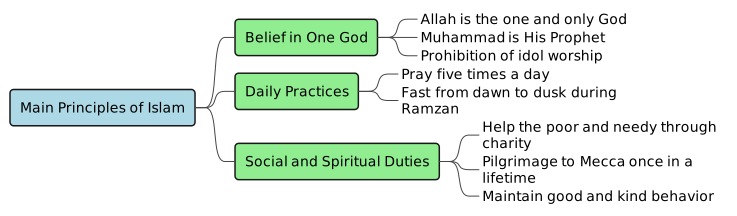
Islam is based on the belief in one God, Allah, and His Prophet Muhammad, with a strong prohibition against idol worship.Followers, known as Muslims, are required to pray five times a day and fast from dawn to dusk during the holy month of Ramzan.They must also perform acts of charity by helping the poor and needy with a portion of their wealth.Additionally, a pilgrimage to Mecca must be undertaken at least once in a lifetime.Throughout their lives, Muslims are expected to maintain a good and kind behavior toward others.
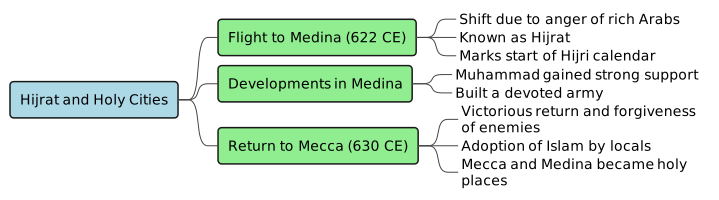
Prophet Muhammad’s teachings of monotheism and prohibition of idol worship angered the wealthy Arabs, forcing him and his followers to migrate to Medina in 622 CE.This historic journey from Mecca to Medina is known as Hijrat, which marks the official beginning of the Muslim calendar called Hijri.While in Medina, Muhammad gained extensive support and established a devoted army to defend and spread the message of Islam.In 630 CE, he returned victoriously to Mecca, where he forgave his enemies, prompting the local population to adopt the Islamic faith.This historical progression officially established both Mecca and Medina as the two sacred holy places of Islam.
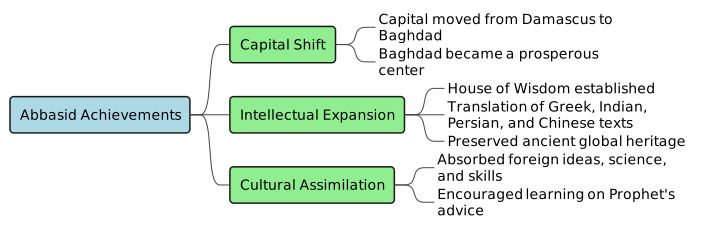
The Arab empire achieved its greatest intellectual and cultural excellence during the reign of the Abbasid Caliphs, who moved the capital to Baghdad.Under their rule, Baghdad grew into an exceptionally powerful, prosperous, and enlightened global hub of knowledge.To actively promote education, the Abbasids established the House of Wisdom to translate the collective scientific and literary works of ancient civilizations.Arab scholars translated invaluable texts from Greek, Byzantine, Egyptian, Chinese, Indian, and Persian heritages into Arabic.Through this systematic assimilation of foreign ideas and sciences, Baghdad became a critical repository of ancient global culture.
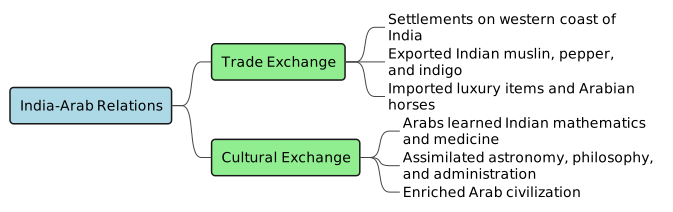
Arab traders established several commercial settlements along the western coast of India, often marrying locally and integrating into Indian society.Indian merchants routinely used Arab vessels to export high-demand items such as muslin, pepper, and indigo to the West.In return, the Arabs brought luxury goods and premium Arabian horses to Indian markets.Crucially, the Arabs assimilated extensive Indian expertise in mathematics, medicine, astronomy, philosophy, and administrative practices.This profound cultural and scientific exchange led to the enrichment of Arab civilization and helped spread Indian knowledge globally.

Share
Explore
 Long Answers
Prepared by: learnloophq@gmail.com
Chapter: 03. Birth Of Prophet Muhammad And Spread Of Islam
1. What are the main principles and teachings of Islam?
2. Explain the significance of Hijrat and how Mecca and Medina became the holy places of Islam.
3. Discuss the intellectual and cultural achievements of the Arab empire under the Abbasid Caliphs.
4. Describe the trade and cultural relations between India and the Arab world during the medieval period.
Want to print your doc?
This is not the way.
This is not the way.

Try clicking the ··· in the right corner or using a keyboard shortcut (
CtrlP
) instead.