Skip to content
Definition: A period of transition from the ancient to the modern world.Timeline: Spanned about 900 to 1,000 years, from the early 7th century CE to the early 16th century CE (periodization varies among historians).
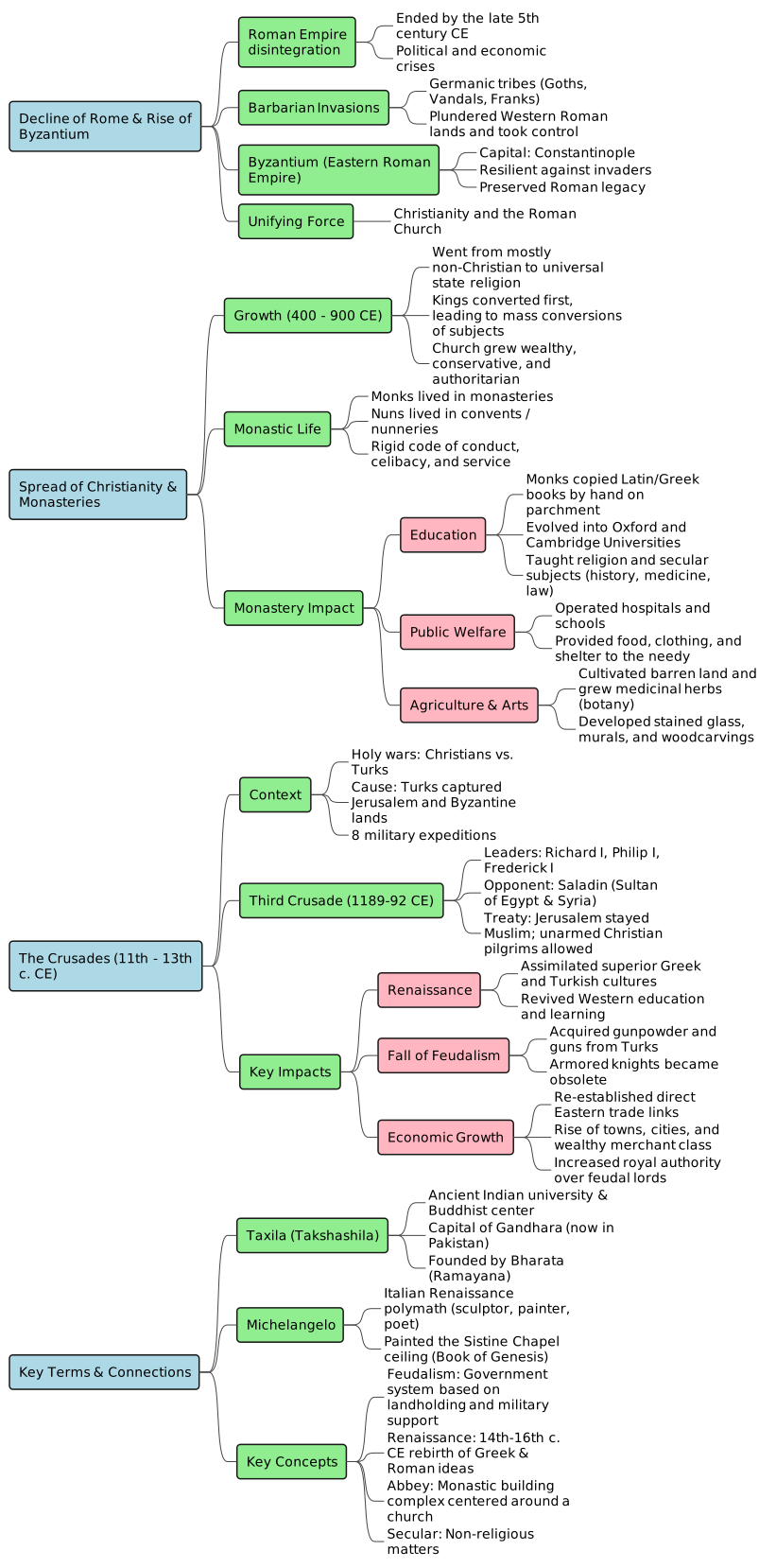
Disintegration: Began by the end of the 5th century CE.Causes of Fall:Barbarian Invasions: Repeated attacks and plundering by Germanic tribes (Goths, Vandals, and Franks) who settled in and took control of the western territory.Internal Crises: Severe political and economic crises.Unifying Factor: With the collapse of Western European political unity, Christianity and the Roman Church became the primary unifying force.
Division (395 CE): The Roman Empire split into the Western and Eastern parts.Byzantium: The Eastern Roman Empire, with its capital at Constantinople (modern-day Istanbul).Resilience: Successfully withstood barbarian attacks, preserved the legacy of the classical Roman Empire, and interacted with Germanic tribes who adopted Roman culture over time.
Mass Conversions: The conversion of a king or feudal lord was typically followed by the mass conversion of their subjects.Power & Wealth: As the religion spread, the Church’s land, wealth, and political influence multiplied.Shift in Character: With growing power, the Church became conservative and authoritarian, demanding absolute obedience and total submission from Christians.
Monks: Pious priests who lived as hermits in remote, isolated places. They did not marry and dedicated their lives to spiritual matters and service.Nuns: Women who took similar vows of celibacy and service. They lived in separate communities called convents or nunneries.Abbey: The central monastery complex containing a small church, living quarters, a kitchen, storerooms, gardens, orchards, and ponds.Code of Conduct: Simple, orderly, and highly rigid.
The Crusades: A series of eight military holy wars waged by European Christians against the Muslim Turks.Triggers: The Turks invaded Byzantine lands (Constantinople) and captured Jerusalem (the Christian Holy Land). The Pope appealed to Western Christians to reclaim it.
Objective: Attempt by European leaders to recapture Jerusalem from Saladin (Sultan of Egypt and Syria).Key Leaders:Richard I (Richard the Lionheart) of EnglandPhilip I of FranceFrederick I (Frederick Barbarossa) of the Holy Roman Empire (drowned before reaching the Holy Land)Outcome: Richard I conquered the walled city of Acre (1191 CE) and negotiated a treaty. Jerusalem remained under Muslim control, but unarmed Christian pilgrims were granted access.
Cultural Revival (The Renaissance): Crusaders interacted with the advanced civilizations of the Greeks and Turks, assimilating their knowledge and initiating the revival of Western education.Decline of Feudalism:Crusaders learned the use of gunpowder and guns from the Turks.Armored knights lost their military utility.Feudal lords lost power as kings raised professional armies paid for by merchant taxes.Economic Expansion:Re-established direct trade links with the East to meet the demand for luxury items.Led to the growth of new towns, cities, and a flourishing commercial economy.Rise of Royal Authority: Wealthy merchants demanded better law and order, choosing to pay taxes directly to the king, strengthening central monarchies.
Taxila (Takshashila): An ancient Indian university and Buddhist center of learning. According to the Ramayana, it was founded by Rama’s brother, Bharata. Mentioned in Jataka literature as the capital of Gandhara. The ruins are located in present-day Pakistan.Michelangelo: An iconic Italian Renaissance sculptor, painter, architect, and poet. He spent four years painting the ceiling of the Sistine Chapel, depicting over 300 figures and nine episodes from the Book of Genesis.

Share
Explore
 Recap Hub
Prepared by: learnloophq@gmail.com
Chapter: 02. Spread Of Christianity
Crash Course Revision Material: Spread of Christianity
1. Medieval Period & The Decline of the Roman Empire
Overview of Medieval Europe
Fall of the Western Roman Empire
The Byzantine Empire (Eastern Roman Empire)
2. The Spread of Christianity (400 CE – 900 CE)
[400 CE: Most of Europe is non-Christian] ➔ ➔ [By 900 CE: Christianity is the state religion in every European state]
Dynamics of Conversion
3. Monasteries and Their Multi-Dimensional Impact
Monastic Life
Key Contributions of Monasteries
Field
Contributions & Impact
Education
• Acted as key medieval centers of scholarship.• Monks copied religious (e.g., the Bible) and Greek/Latin secular texts by hand on parchment.• Evolved into world-famous secular universities (e.g., Oxford and Cambridge), teaching history, philosophy, medicine, law, and astrology.
Welfare & Health
• Operated schools, libraries, and hospitals attached to monasteries.• Treated the sick/wounded and gave food, clothing, and shelter to travelers and the poor.
Arts & Crafts
• Supported the development of architecture, mural paintings, woodcarving, and stained glass painting.
Agriculture & Science
• Brought barren surrounding lands under productive cultivation.• Cultivated medicinal herbs in gardens, which revived an interest in botany.
4. The Crusades (11th – 13th Century CE)
Definition and Context
The Third Crusade (1189–1192 CE)
Impacts of the Crusades on Europe
5. Global Connections & Renaissance Figures
PlantUML Mindmap
Want to print your doc?
This is not the way.
This is not the way.

Try clicking the ··· in the right corner or using a keyboard shortcut (
CtrlP
) instead.