Skip to content
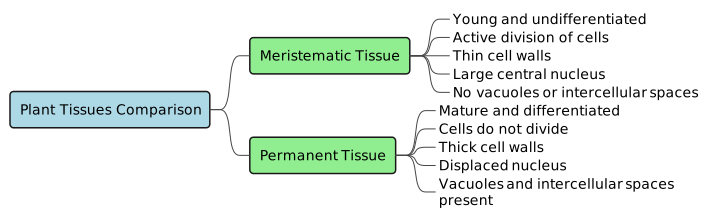
Meristematic tissues consist of young, undifferentiated cells that continuously divide to assist in plant growth, whereas permanent tissues are composed of mature, differentiated cells that have lost the ability to divide. The cell walls of meristematic tissues are thin, and they completely lack intercellular spaces as well as vacuoles. In contrast, permanent tissues have thick cell walls, and their living cells contain large vacuoles and prominent intercellular spaces. Furthermore, the nucleus in meristematic cells is large and centrally located, while in permanent tissue cells, the nucleus is displaced to one side. While meristematic tissues are restricted to growing points like root and shoot tips, permanent tissues are widely distributed and form the bulk of the plant body.
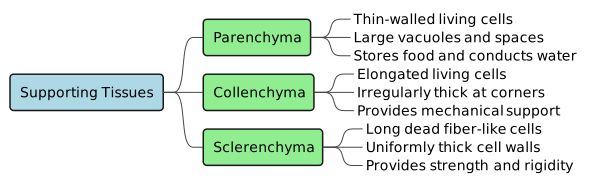
Supporting tissues provide strength and structural support to plants and are classified into parenchyma, collenchyma, and sclerenchyma. Parenchyma consists of loosely packed, thin-walled living cells with large vacuoles that function to store food materials, form ground tissue, and assist in photosynthesis and water conduction. Collenchyma is formed of elongated living cells with walls irregularly thickened at the corners, providing mechanical support to leaves, stems, and petioles without having intercellular spaces. Sclerenchyma is composed of long, dead, and fiber-like cells with uniformly thick cell walls that offer mechanical strength and rigidity to plant parts. These three tissues are distributed differently, with parenchyma widely spread in soft parts, collenchyma located below the epidermis, and sclerenchyma situated around vascular bundles.
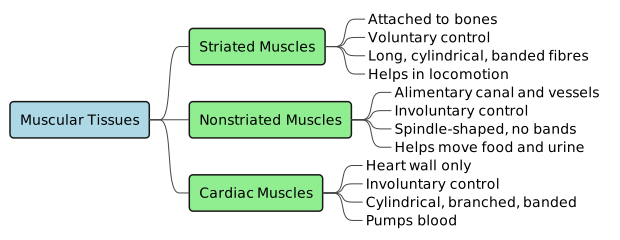
Animal muscular tissues are contractile tissues made of long muscle fibres containing myofibrils, and they are divided into striated, nonstriated, and cardiac muscles. Striated muscles are voluntary, skeletal muscles attached to bones, consisting of long, cylindrical, unbranched fibres with prominent light and dark bands. Nonstriated muscles are involuntary, smooth muscles found in the walls of the alimentary canal, blood vessels, and urinary bladder, characterized by spindle-shaped, unbranched fibres lacking bands. Cardiac muscles are involuntary muscles found exclusively in the heart wall, possessing cylindrical, branched fibres that also feature light and dark bands. Together, these tissues facilitate locomotion, the movement of food through the digestive tract, and the continuous pumping of blood throughout the body.
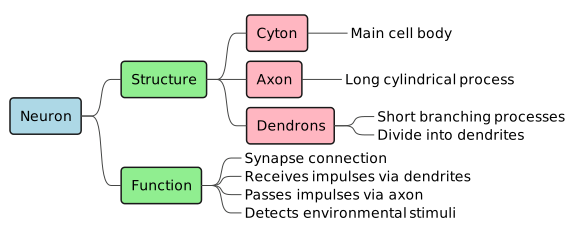
A neuron, or nerve cell, is the structural and functional unit of nervous tissue, which is specialised for coordinating various life activities. Structurally, each neuron is divided into three distinct parts: a cell body called the cyton, a long cylindrical process called the axon, and short branching processes called dendrons. The dendrons branch further into fine dendrites, which receive nerve impulses from the axons of adjacent neurons across a connection called a synapse. The received impulses are transferred to the cyton, which then passes them along the axon to be transmitted to the next adjacent neuron. In this manner, neurons in sense organs detect environmental stimuli and transmit these messages as nerve impulses to the brain or spinal cord for appropriate responses.
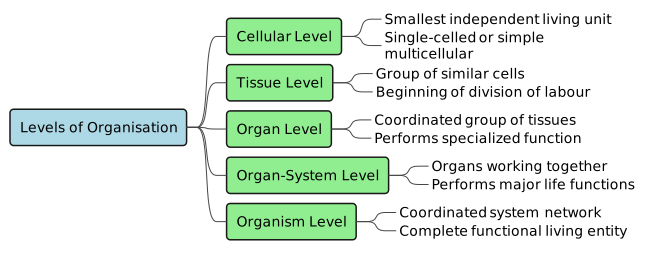
Biological organisation in multicellular organisms is structured hierarchically, beginning at the cellular level where cells act as the basic unit of life. At the tissue level, structurally similar cells that perform a common function group together to carry out specialized tasks, marking the beginning of division of labour. Different tissues then work together in a coordinated manner to form organs, such as the stomach or lungs, which perform specific life functions. Multiple organs integrate their activities to form an organ system, such as the digestive or circulatory system, which carries out major life functions. Finally, all these organ systems work collectively and harmoniously to constitute a complete, well-organised multicellular organism.

Share
Explore
 Long Answers
Prepared by: learnloophq@gmail.com
Chapter: 01. Tissues
Long Answer Question Bank
1. Explain the differences between meristematic and permanent tissues in plants.
2. Describe the three types of supporting tissues found in plants and their respective functions.
3. Discuss the different types of muscular tissues in animals along with their structural features and locations.
4. Describe the structure and working mechanism of a neuron.
5. Explain the different levels of biological organisation in multicellular organisms starting from the cell.
Want to print your doc?
This is not the way.
This is not the way.

Try clicking the ··· in the right corner or using a keyboard shortcut (
CtrlP
) instead.