Skip to content
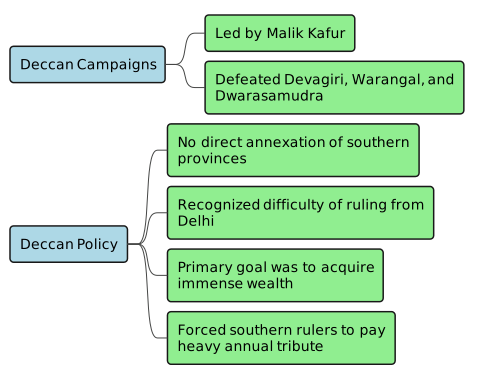
Describe the Deccan policy of Alauddin Khilji and the underlying reasons for adopting it.Alauddin Khilji was the first Turkish ruler to send military expeditions to the Deccan, which were led by his general, Malik Kafur.After defeating the rulers of Devagiri, Warangal, and Dwarasamudra, Alauddin far-sightedly chose not to annex these southern provinces.He realized that it would be extremely difficult to control these distant territories effectively all the way from Delhi.His primary objective was to acquire massive wealth from the south to maintain his huge standing army and administer his empire.Consequently, he forced the Deccan rulers to acknowledge his supremacy and pay a heavy annual tribute as a mark of submission.
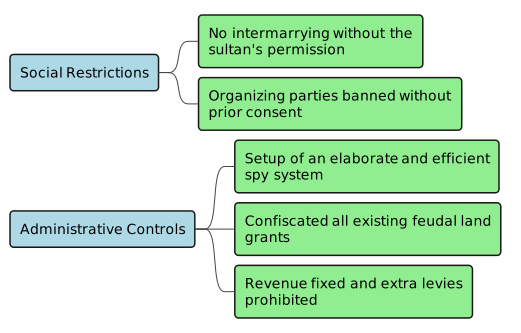
 Explain the strict measures introduced by Alauddin Khilji to curb the power of his nobles.To prevent conspiracies and series of rebellions, Alauddin Khilji placed severe restrictions on the social interactions of his nobles.Nobles were strictly forbidden from organizing parties or intermarrying without obtaining the prior consent of the sultan.He established an elaborate and highly efficient spy system that promptly reported everything the nobles did in public and private to the sultan.Additionally, he confiscated all feudal land grants and made new grants where landholders were only entitled to a fixed portion of revenue.Under these new land reforms, landholders were prohibited from levying any additional taxes on the peasants.
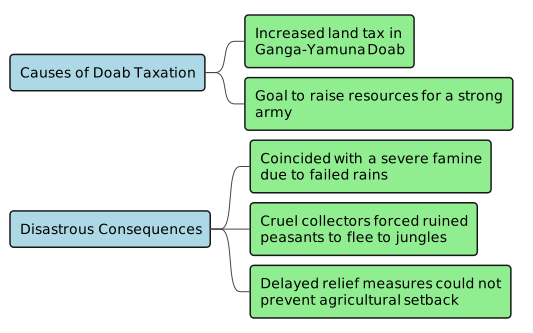
 Discuss the causes and disastrous consequences of Muhammad bin Tughlaq’s taxation scheme in the Ganga-Yamuna Doab.To enhance his military resources and secure his ruling position, Muhammad bin Tughlaq increased the land tax in the fertile Ganga-Yamuna Doab region.Unfortunately, this policy coincided with a failure of rains which triggered a severe famine across the region.Cruel tax collectors showed no mercy and rigorously collected the enhanced taxes, completely ruining the local peasants.To escape this extreme tyranny, the peasants abandoned their lands and fled to the safety of the jungles.Although the sultan later introduced relief measures like free kitchens and agricultural loans, the remedy came too late and agriculture suffered a severe setback.
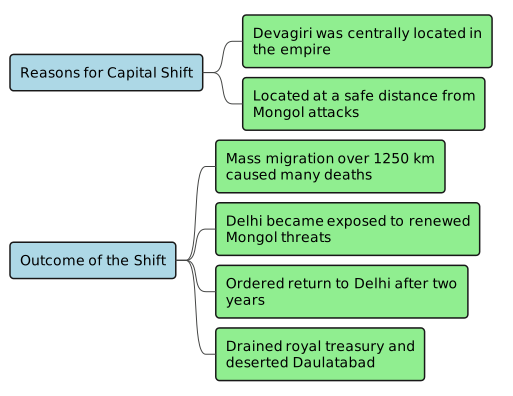
 Analyze the reasons for and the ultimate outcome of Muhammad bin Tughlaq’s transfer of the capital.Muhammad bin Tughlaq decided to transfer his capital from Delhi to Devagiri, which he renamed Daulatabad, to secure a centrally located capital.This new location was nearly equidistant from all important parts of his empire and offered safety from repeated Mongol invasions.Rather than shifting only his court, the sultan ordered the entire population of Delhi to undertake the arduous 1,250 km journey.Many people died during the long journey, and the homesick survivors struggled to adjust to the alien conditions of Daulatabad.Realizing his mistake as Delhi became vulnerable to northern attacks, the sultan ordered everyone to return after two years, leaving the treasury drained and Daulatabad deserted.
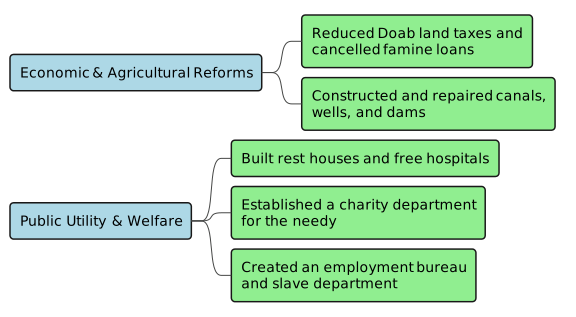
 Detail the key economic and public utility reforms introduced by Firoz Shah Tughlaq for the welfare of his subjects.Firoz Shah Tughlaq was a peace-loving, benevolent ruler who made the welfare and material prosperity of his subjects his primary concern.He reduced land taxes in the fertile Doab region, cancelled all outstanding loans given during the famine, and abolished many other taxes.To boost agricultural production, he repaired old canals, dug hundreds of wells, built new canals, and constructed multiple dams.He established numerous works of public utility, including rest houses for travelers, free hospitals for the poor, and a dedicated charity department.Furthermore, he set up an employment bureau to provide jobs for the unemployed and a separate department to look after slaves.

Share
Explore
 Long Answers
Prepared by: learnloophq@gmail.com
Chapter: 05. Expansion Of The Delhi Sultanate The Khilji And The Tughlaq Dynasties
Want to print your doc?
This is not the way.
This is not the way.

Try clicking the ··· in the right corner or using a keyboard shortcut (
CtrlP
) instead.