Skip to content
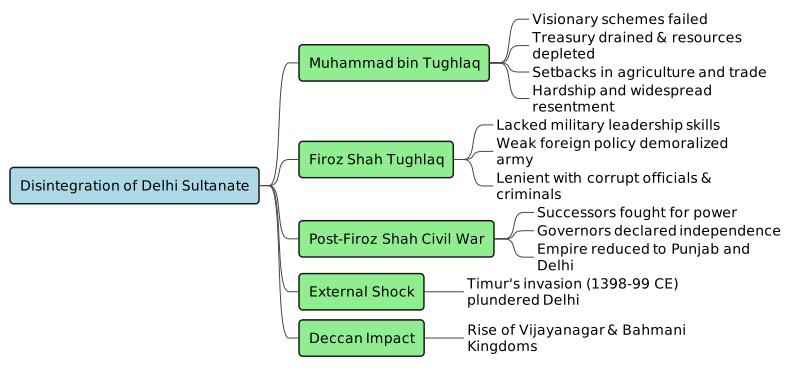
Failure of Schemes: The visionary but impractical schemes of Sultan Muhammad bin Tughlaq drained the state treasury and depleted the government’s resources.Economic Setback: Both agriculture and trade suffered a severe setback under Muhammad bin Tughlaq’s reign.Public Discontent: The misery, hardship, and agony experienced by the general populace caused widespread resentment against the Sultan’s rule.Military and Prestige Loss: The sultanate’s army suffered heavy casualties, and the personal prestige of the Sultan received a serious blow.Widespread Revolts: Revolts broke out across the Turkish empire, giving rise to independent and powerful kingdoms in Rajasthan, Bengal, Sindh, and the Deccan (specifically the Vijayanagar and Bahmani kingdoms).Weak Military Leadership: Firoz Shah Tughlaq lacked the basic qualities required of a military commander. His weak foreign policy demoralized the army and emboldened the enemies of the Sultanate.Administrative Decay: Firoz Shah’s leniency towards corrupt officials and criminals weakened the administration and sapped the vitality of the state.Civil War: The death of Firoz Shah was followed by a civil war among his descendants, causing numerous revolts as powerful provincial governors declared their independence. Ultimately, the Tughlaq empire was reduced to only Punjab and the area around Delhi.The Final Blow: The Mongol ruler Amir Timur invaded India in 1398–99 CE and mercilessly plundered Delhi, dealing the final blow to the Tughlaq dynasty.
North India: Rocked by political turmoil and instability as the Delhi Sultanate disintegrated.South India: Enjoyed a remarkable period of stability and prosperity that lasted for more than 200 years.
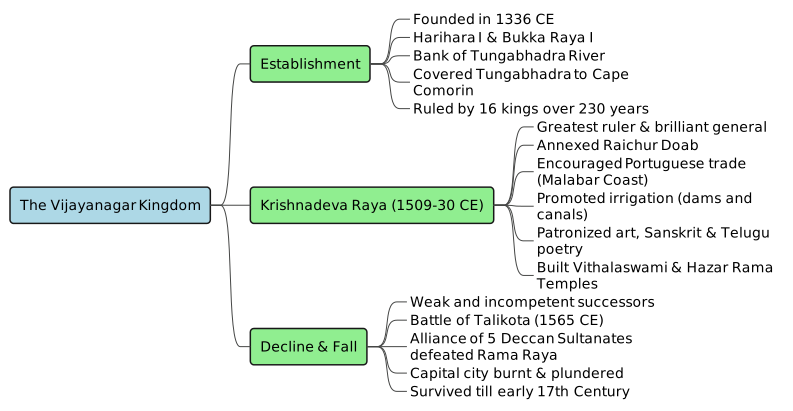
Founders: Established by two brothers, Harihara I and Bukka Raya I.Territorial Extent: Through several wars with neighboring states, the founders brought the entirety of South India—from the river Tungabhadra to Cape Comorin—under their control.
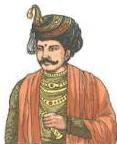
Military Leadership: A brilliant military general, he won outstanding victories and annexed the Raichur Doab—the perennially contested, fertile territory between the Vijayanagar and Bahmani kingdoms.Foreign Trade Support: He actively encouraged foreign trade with the Portuguese, who had established trade centers on the Malabar Coast, earning rich revenue via custom duties and other taxes.Agricultural Development: Developed essential irrigation facilities by building dams and canals to promote agricultural yield.Patronage of Literature: He was a fine Telugu poet and an accomplished Sanskrit scholar. He maintained a magnificent court and patronized regional poets and learned men.Architectural Marvels: He was a great builder. Under his reign, many beautiful temples and impressive mansions were constructed. The most outstanding specimens include:The Vithalaswami TempleThe Hazar Rama Temple
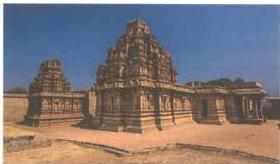
Weak Successors: After the death of Krishnadeva Raya, the glory and power of the kingdom faded due to weak and incompetent successors.The Battle of Talikota (1565 CE): During the reign of Rama Raya, a combined alliance of five Deccan Sultanates (Bijapur, Ahmadnagar, Berar, Golconda, and Bidar) inflicted a crushing defeat on the Vijayanagar kingdom.Aftermath: The capital city of Vijayanagar was thoroughly burnt, plundered, and ravaged by the victors. This battle sounded the death knell of the Hindu kingdom in the south. Although the kingdom survived and continued to exist until the beginning of the 17th century CE, it never regained its former power and glory.
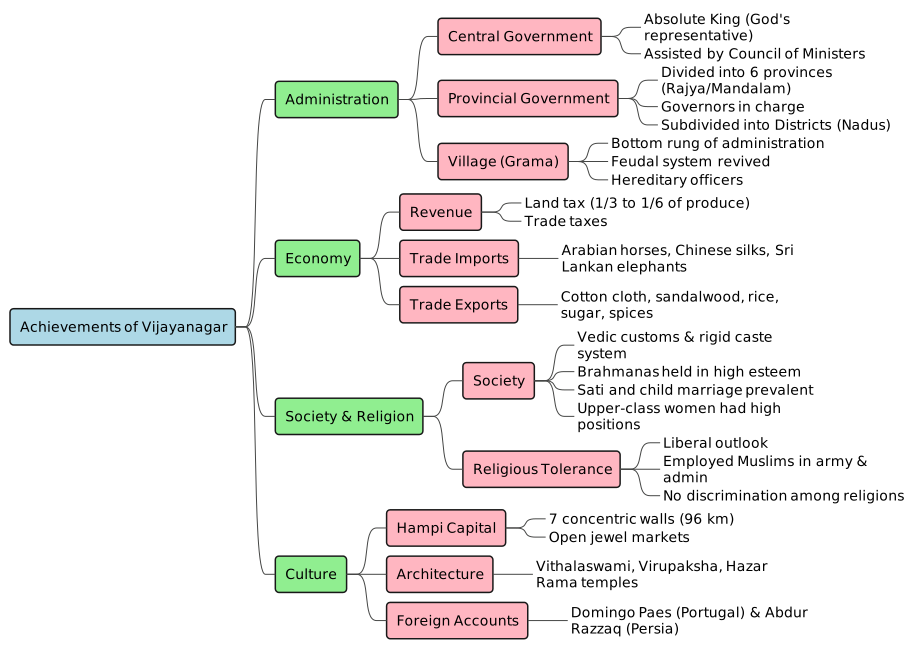
Revenue Sources: The state treasury was enriched primarily through land taxes and trade taxes.Land Tax Assessment: Land tax varied from one-third to one-sixth of the produce. Taxes were levied only after assessing the quality of the land.Agricultural Reforms: Forests were cleared to bring more land under cultivation. Tanks, canals, and dams were built for systematic irrigation.Foreign Trade and Markets:Imports: Arabian horses, Chinese silks, and Sri Lankan elephants.Exports: Cotton cloth, sandalwood, rice, sugar, and spices.
Social Practices: The society was conservative and governed strictly by religious norms. The rulers revived ancient Vedic customs.Caste System: The caste system was highly rigid, and Brahmanas were extremely powerful and held in high esteem.Status of Women: Women were respected in general but did not enjoy much freedom. Child marriage and sati (where a widow sacrificed herself on her husband’s funeral pyre) were common practices. However, a few upper-class women occupied high positions and participated in social, literary, and political affairs.Religious Tolerance: Although the Vijayanagar kings were staunch Hindus, they maintained a liberal and tolerant outlook. They employed Muslims in their army and administration. There was no discrimination among Hindus, Muslims, Christians, and Jews.
Fortifications: The city was surrounded by seven concentric walls, boasting a total circumference of 96 kilometers.Infrastructure: Streets were paved and well-planned. The city was adorned with gardens, lakes, grand mansions, and temples.Bazaars: Abundant flowers like fresh sweet-scented roses were sold daily. According to foreign accounts, everyone wore jewelry, and precious stones like diamonds, rubies, pearls, and emeralds were sold openly in the crowded, bustling bazaars.
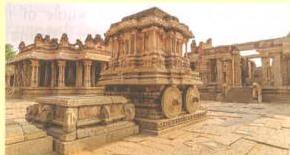
Temple Specimen: The ruins of Hampi showcase the architectural grandeur of the era. The Vithalaswami Temple, the Virupaksha Temple, and the Hazar Rama Temple are the finest specimens of temple architecture of this period.Fine Arts: Painting, sculpture, music, and dance made remarkable progress.Languages: The kings patronized both Sanskrit and regional languages. The development of regional literatures in Telugu, Malayalam, Tamil, and Kannada received a massive boost.
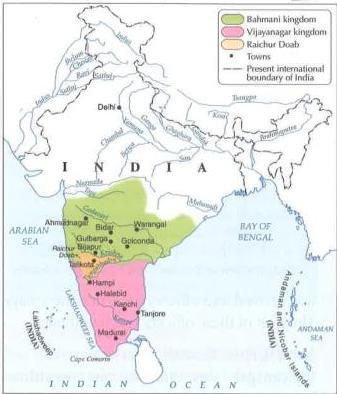
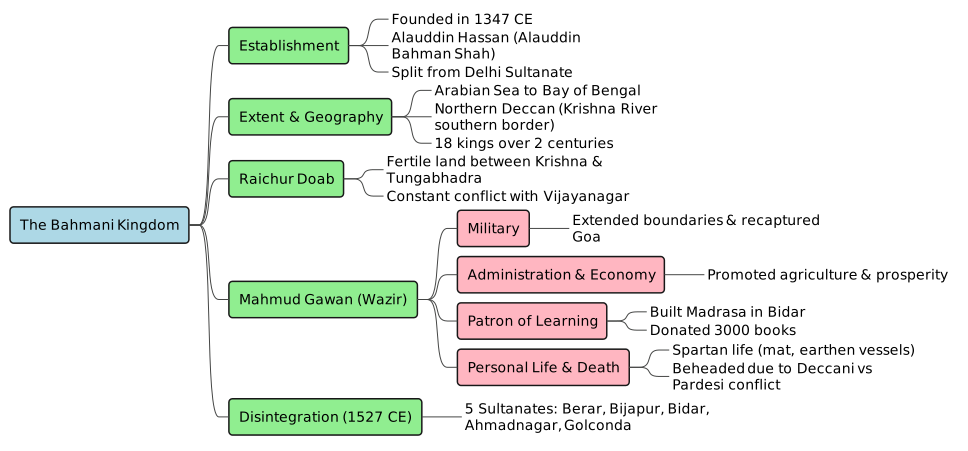
Power and Reach: It was the most powerful independent Muslim kingdom in the Deccan.Territorial Extent: Stretched from the Arabian Sea in the west to the Bay of Bengal in the east. It included the entire northern Deccan, with the river Krishna forming its southern boundary.Political History: Lasted for about two centuries under eighteen kings. The kingdom was frequently rocked by political turmoil, assassinations, and prolonged wars with neighboring states such as Warangal, Gujarat, Malwa, and Vijayanagar.
Geography: The Raichur Doab was a highly fertile tract of land lying between the river Krishna (southern boundary of the Bahmani kingdom) and the river Tungabhadra (northern boundary of the Vijayanagar kingdom).Conflict: Because of its immense revenue potential, it became a continuous bone of contention and battleground between the Vijayanagar and Bahmani kingdoms. The territory changed hands constantly.Resolution: Even after the Bahmani kingdom split, the conflict persisted. It was finally resolved in 1565 CE when the Vijayanagar kingdom was decisively defeated at the Battle of Talikota.
Military Success: He was a highly competent general who extended the kingdom’s boundaries and recaptured the key port of Goa from the Vijayanagar kingdom.Economic Administration: Encouraged agriculture systematically, leading to great economic prosperity.Patron of Education: He was a highly learned scholar. He built a famous madrasa (college) in the capital city of Bidar and donated his personal collection of 3,000 books to its library. He also offered scholarships to poor and deserving students.Spartan Lifestyle: Despite his immense power, Gawan lived a simple, spartan life. He slept on a mat, ate out of simple earthen vessels, and spent his wealth on helping the poor and needy.
The Disintegration (1527 CE): The execution of Mahmud Gawan signaled the end of the Bahmani kingdom. By 1527 CE, the empire disintegrated into five independent sultanates:BerarBijapurBidarAhmadnagarGolconda
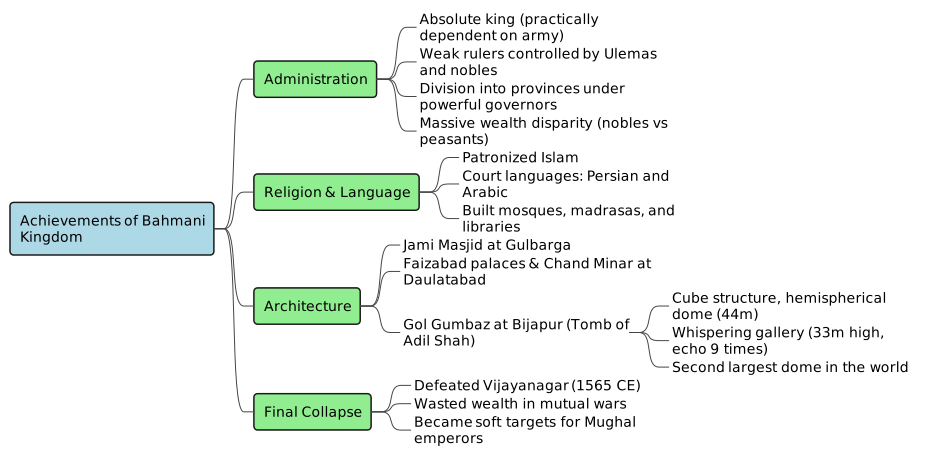
Authority of the King: In theory, the Bahmani Sultan was all-powerful. In practice, his autocratic authority depended heavily on the strength of his army. Weak sultans were easily controlled by the ulemas (Islamic scholars) and powerful nobles.Provincial Setup: The kingdom was divided into provinces, each ruled by a governor appointed by the Sultan. Governors collected revenue (paying a part to the Sultan) and supplied military troops during times of war.Wealth Disparity: While the kingdom was economically prosperous, there was a stark, massive disparity of wealth between the wealthy nobles and the impoverished peasantry.
Religious Patronage: The Bahmani rulers patronized Islam. They built many magnificent mosques, madrasas, and libraries in their capital cities of Gulbarga and Bidar to promote Islamic studies.Court Languages: Persian and Arabic were used as the official languages of the royal court.Architectural Masterpieces:Jami Masjid at GulbargaChand Minar at DaulatabadThe palaces and forts of Faizabad
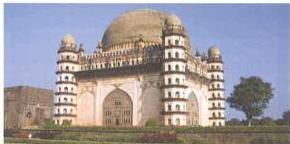
The Structure: Meaning the ‘round dome’, it is a simple but highly impressive cube-like structure surmounted by a massive hemispherical dome.Minarets: The dome is balanced by tall, tapering seven-story minarets at each corner. Each minaret is topped by a small dome.Dimensions: The dome has an external diameter of 44 meters and is cleverly supported by a system of intersecting arches without any central pillar support.The Whispering Gallery: Located 33 meters above the pavement, the dome houses a unique gallery. Due to the incredible acoustics, even the faintest whisper echoes nine times around the dome. It is the second largest whispering dome in the world (the largest is St. Peter’s Basilica in Vatican City).
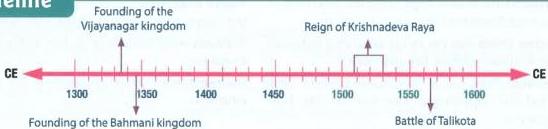
1336 CE: Founding of the Vijayanagar Kingdom by Harihara I and Bukka Raya I.1347 CE: Founding of the Bahmani Kingdom by Alauddin Bahman Shah.1509–1530 CE: Reign of Krishnadeva Raya (the golden period of Vijayanagar).1527 CE: Complete disintegration of the Bahmani Kingdom into five separate sultanates.1565 CE: The Battle of Talikota (The joint Deccan Sultanates defeat Vijayanagar, leading to its destruction).
Domingo Paes (Portugal): A Portuguese traveler who visited the Vijayanagar Empire during the reign of King Krishnadeva Raya. In his work, Chronicle of the Kings of Vijayanagar, he recorded extensive details about the kingdom’s towns, markets, trade goods, factories, and advanced irrigation systems.Abdur Razzaq (Persia): A Persian traveler who visited the Vijayanagar Kingdom in the 15th century CE. Like Paes, he was awed by the incredible wealth and splendor of the capital.
Raichur Doab: The highly fertile, revenue-rich tract of land lying between the river Krishna and river Tungabhadra. It was a constant zone of conflict between the two kingdoms.Pardesis: Foreign nobles within the Bahmani kingdom, often involved in administrative and court rivalries.Deccanis: Local or native nobles of the Deccan region within the Bahmani kingdom.Sati: A historic social practice where a widow sacrificed herself on her husband’s funeral pyre. This practice highlighted deep gender inequality in medieval times and was legally abolished centuries later by the social reformer Raja Ram Mohan Roy.

Share
Explore
 Self Study
Prepared by: learnloophq@gmail.com
Chapter: 07. Rise Of The Vijayanagar And Bahmani Kingdoms
Theme 4: The Vijayanagar and Bahmani Kingdoms
1. Disintegration of the Delhi Sultanate
The Delhi Sultanate reached the zenith of its power during the reign of the Tughlaq dynasty. However, this dynasty also sowed the seeds of its own destruction, rendering the final collapse of the Delhi Sultanate inevitable.
Major Causes of Disintegration
Political Contrast: North vs. South India (1335 CE – 1530 CE)
2. The Vijayanagar Kingdom
The Vijayanagar Kingdom (“City of Victory”) was established in 1336 CE on the banks of the river Tungabhadra. It was one of the most powerful Indian kingdoms, lasting for about 230 years and ruled by a total of sixteen kings.
Krishnadeva Raya (1509–1530 CE)
Krishnadeva Raya was the greatest ruler of the Vijayanagar kingdom. During his reign, the kingdom reached the height of its glory and established itself as the strongest military power in South India.
Key Achievements of Krishnadeva Raya
Decline of the Vijayanagar Kingdom
3. Achievements and Life in the Vijayanagar Kingdom
Administration
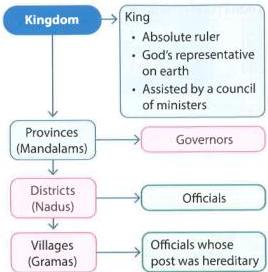
The administrative structure of the Vijayanagar empire was highly organized and hierarchical.
Hierarchy of Administration
Level
Administrative Unit
Governing Authority
Key Characteristics
Top
Central Government
The King (assisted by a Council of Ministers)
Absolute ruler; his will was law; worshipped by the people as God’s representative on earth.
Middle
Provinces (Rajya or Mandalam)
Governor
Six provinces in total; the Governor was directly responsible for the administration of his province.
Sub-division
Districts (Nadu)
Designated Officials
Managed local affairs and coordinated with the provinces.
Bottom
Villages (Grama)
Hereditary Officers
Bottom rung of the administrative ladder; governed under a revived old feudal system; posts were hereditary.
Economic Conditions
During the 15th and 16th centuries CE, Vijayanagar was recognized as one of the wealthiest kingdoms in the world.
Society and Religious Tolerance
The Capital City: Hampi
The magnificent capital city of Vijayanagar was built around Hampi, a sacred pilgrimage site (tirth).
Literature, Art, and Architecture
4. The Bahmani Kingdom
The Bahmani kingdom was established in 1347 CE by Alauddin Hassan (an official of the Delhi Sultanate during the reign of Muhammad bin Tughlaq). Upon ascending the throne, he took the title of Alauddin Bahman Shah.
The Battleground: Raichur Doab
Mahmud Gawan: The Great Wazir
The Bahmani kingdom reached the zenith of its power under Mahmud Gawan, who served as the wazir (prime minister) to Muhammad Shah III.
Conspiracy and Fall
A chronic internal issue within the Bahmani kingdom was the continuous conflict between local nobles (Deccanis) and foreign nobles (Pardesis). Mahmud Gawan, being a Pardesi, became the target of a conspiracy by the Deccani nobles. He was falsely implicated and beheaded on the orders of the Sultan.
Although these five kingdoms were constantly at war with one another, they united briefly in 1565 CE to defeat Vijayanagar.
5. Achievements and Administration of the Bahmani Kingdom
Administration and Social Disparity
Art, Architecture, and Culture
The Gol Gumbaz (Bijapur)
Built by the successors of the Bahmani rulers, the Gol Gumbaz is the tomb of King Adil Shah of Bijapur.
The End of the Deccan Sultanates
The persistent threat of the mighty Vijayanagar empire had kept the Bahmani Sultans highly vigilant and alert. Once the Vijayanagar kingdom was destroyed at Talikota, this external threat disappeared. Consequently, the Deccan sultans became complacent, frittered away their vast wealth in mutual warfare, and ultimately became soft, exhausted targets for the expanding Mughal Empire from the north.
6. Chapter Summary & Key Concepts
Timeline of Major Events
Comparative Flowchart of the Two Kingdoms
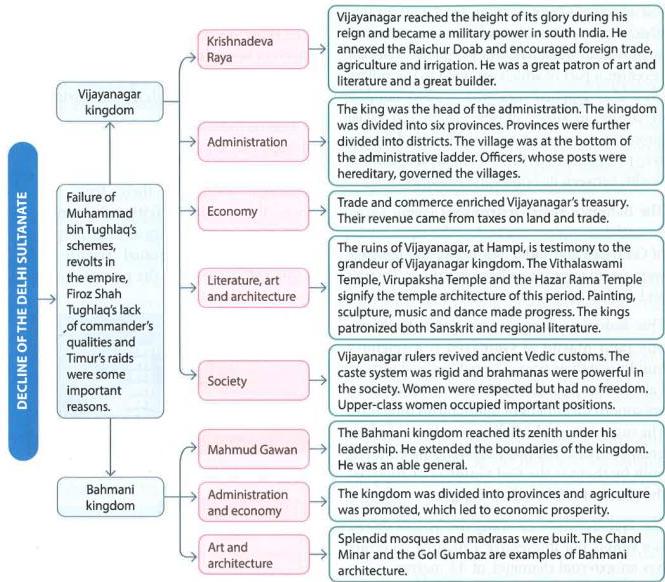
Primary Historical Sources
Our primary knowledge about the grandeur, administration, and life within these kingdoms comes from the detailed writings of foreign travelers:
Glossary of Key Terms
Want to print your doc?
This is not the way.
This is not the way.

Try clicking the ··· in the right corner or using a keyboard shortcut (
CtrlP
) instead.