Skip to content

Corporate client drawings should be finished to level four standards in most circumstances.Drawings that have already been developed in previous stages, and you are now concentrating on final design details.A site survey has been completed so sign type and dimensions can be finalized.The drawing is a repeat of a previous job.The drawing request is for straight-forward jobs, such as flat panel signs, decals, or banners.The client provides artwork that can be easily applied to the requested sign type.
Channel letters.Routed face with push-thru letters.Non-illuminated acrylic letters.Single-face cabinets.Aluminum, wood, and column decor.
Design Toolkit
- Pages


 Drawing Stage Four - Firm Pricing and Corporate Client Drawings
Last edited 1134 days ago by Adam Doll.
What is a stage four drawing?
Stage four drawings are intended to address all art related details. A firm price quote can be supplied from a stage four drawing. The difference between stage three and four is that we typically have a site survey for stage four. If you have previously completed a stage three drawing and have now received a site survey, the drawing should move to stage four. If there is a change to the sign because of survey details, it may need to go back to estimating for a price adjustment.
Corporate client drawings often start at stage four, as we typically have more information from the start, and they require pricing earlier than a one-off customer who is still considering design options. Corporate client drawings usually have a corporate logo stamp on the right sidebar instead of a drawing stage stamp. These icons can be found in the library, refer to THIS DIAGRAM for examples.
When can a job start or move to stage four?
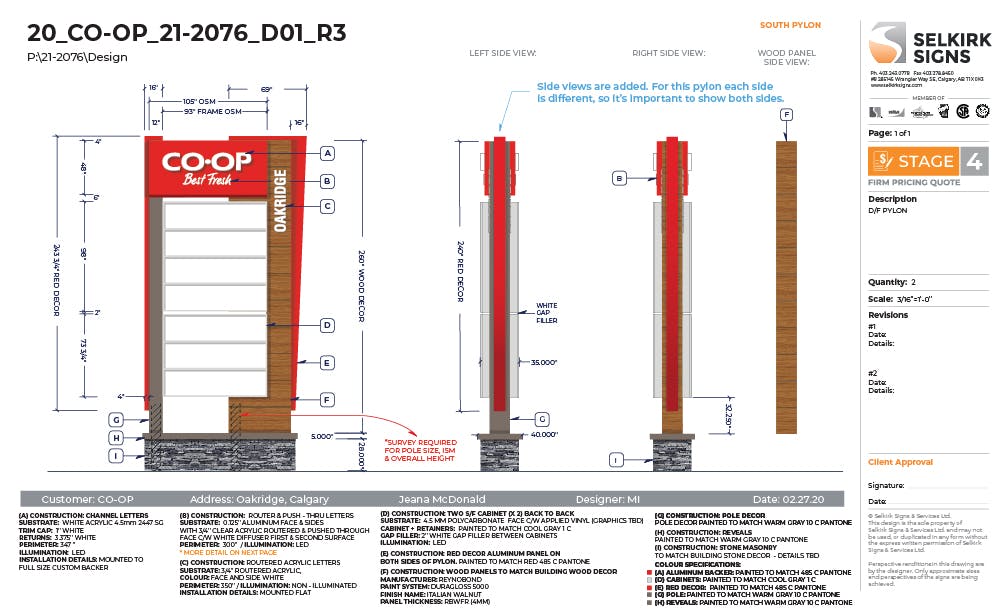
Below is an example of a stage four drawing. Survey details of the existing columns have been added, the specifications are updated to provide further clarity, and we have now included side profile views. Side view depths have not been added because the drafting team may need to be involved to determine the ideal depth. These sign cabinets will be mounted back-to-back on the existing column. Refer to THIS SECTION for illuminated single face cabinet depths.
The pylon below requires specifications for the following sign types:
Want to print your doc?
This is not the way.
This is not the way.

Try clicking the ··· in the right corner or using a keyboard shortcut (
CtrlP
) instead.