Skip to content

Share
Explore
Iron Triangle Tool
** Select the Iron Triangle parameters to view likely feasibility and quality of project outcome.
Scope:
Small Scope
Budget:
Small Budget
Time:
Short Timeline
Results for
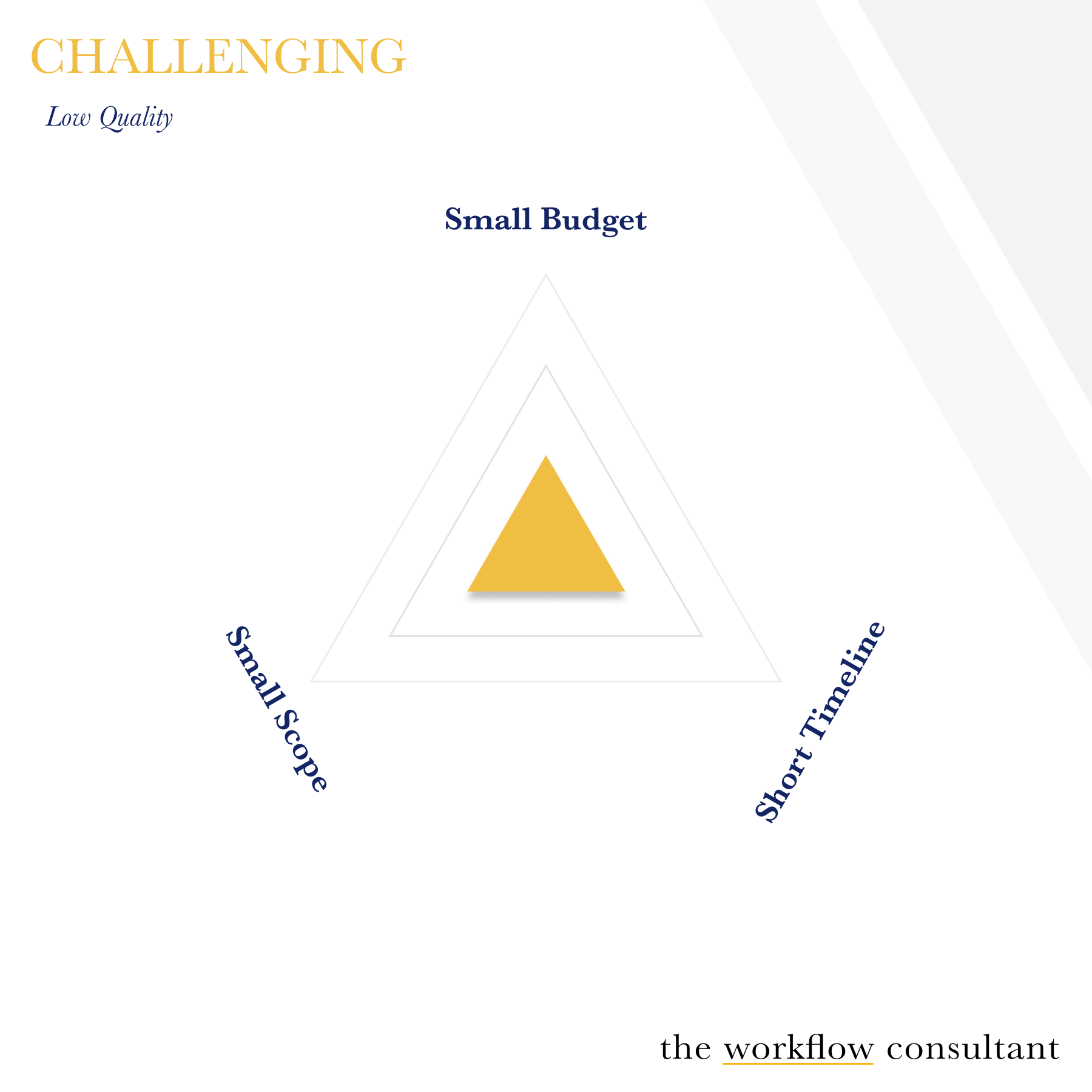
A project that has a , , and a .
Small Scope
Small Budget
Short Timeline
Details
Limited resources and time will impact quality.
Feasibility
Challenging
Challenging
Quality
Low Quality
Low Quality
Background & Definitions
Project Management Iron Triangle Tool
The “Iron Triangle”, also known as the “Triple Constraint”, is a fundamental concept in project management. It highlights the three primary constraints that influence project outcomes: Scope, Budget, and Timeline. These three elements form a triangle, where changing one constraint will inevitably affect the others. Achieving the desired quality within a project depends on balancing these constraints effectively.
The Iron Triangle is a visual representation used by project managers to understand and communicate the trade-offs involved in project planning and execution. It serves as a guide for making informed decisions to meet project goals and stakeholder expectations.
History of the Iron Triangle
The Iron Triangle concept has its roots in the 1960s, emerging as a way to encapsulate the key challenges faced by project managers. Dr. Martin Barnes introduced the concept, emphasizing that project success is determined by managing time, cost, and scope effectively. Over the years, the Iron Triangle has become a cornerstone of project management theory, helping professionals navigate the complexities of project planning and control.
Purpose of This Tool
This Project Management Iron Triangle Tool is designed to help visualize and analyze the interactions between scope, budget, and timeline for different project scenarios. By understanding how these constraints impact project quality and feasibility, you can make better decisions, optimize resource allocation, and set realistic expectations with stakeholders. The tool provides a comprehensive overview of various combinations of scope, budget, and timeline, offering insights into the potential outcomes and challenges associated with each configuration.
Definitions
Term
Definition
Scope
The extent of the work that needs to be done to deliver a product, project, or service. It includes all the tasks, deliverables, and goals that need to be achieved.
Budget
The total amount of money allocated for the project. It includes all costs related to resources, labor, materials, and any other expenses required to complete the project.
Timeline
The schedule or timeframe within which the project must be completed. It includes all milestones, deadlines, and time-related constraints.
Quality
The standard of the project's deliverables. It reflects how well the project's output meets the requirements and expectations of stakeholders.
Feasibility
The degree to which a project is achievable within the given constraints of scope, budget, and timeline, considering the resources available and the potential challenges.
There are no rows in this table
Want to print your doc?
This is not the way.
This is not the way.

Try clicking the ··· in the right corner or using a keyboard shortcut (
CtrlP
) instead.